
Drozdovtsy Artillery
Most of the uniform information comes from "The RCW 1917-1922: White Armies", by A. Deryabin, (AST), which is a Russian equivalent of the Osprey Men-At-Arms series.
Artillery Uniforms
Like the rest of the Drozdovtsy, the artillery portion arrived at the Volunteer Army in May 1918 with a lot of equipment and in good shape.
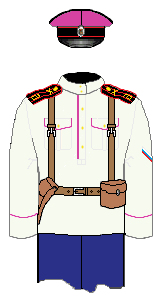
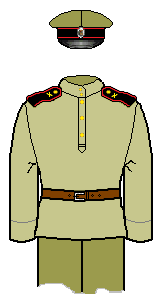
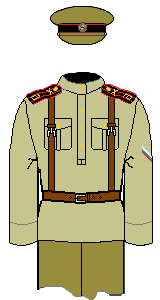
They took the traditional colours for rifle artillery as a base, but with blue trousers like all the "coloured" artillery.
 |
 |
 |
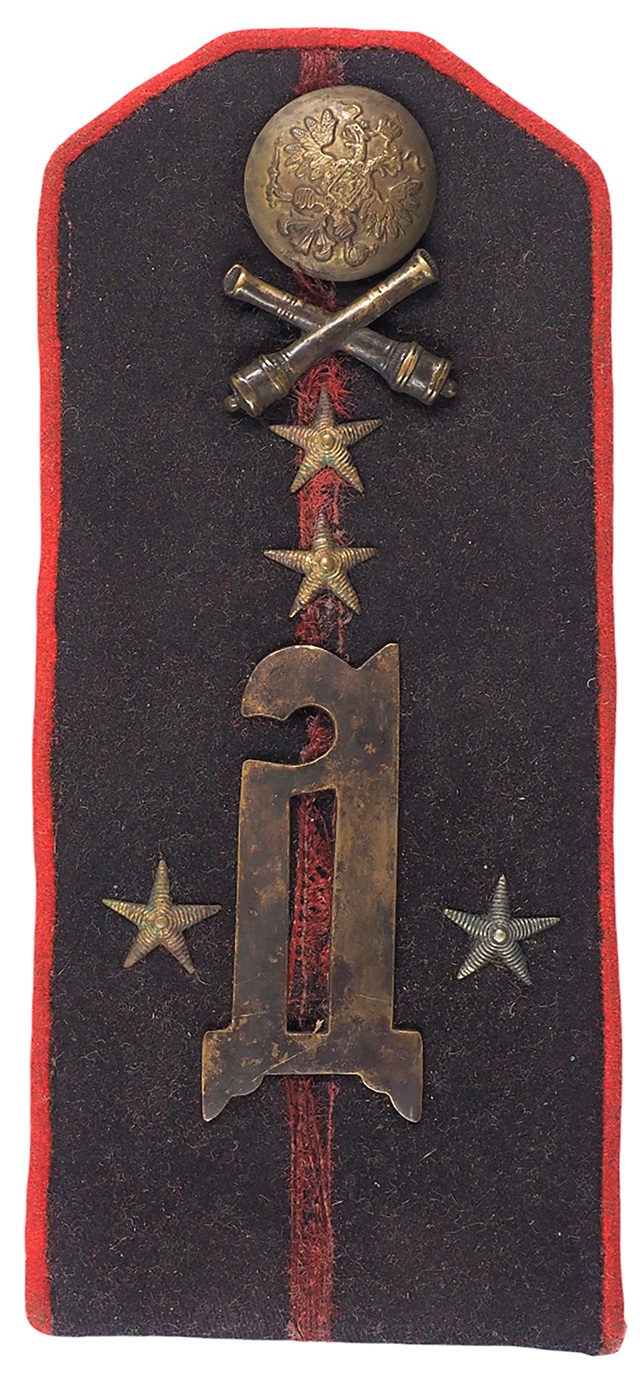 |
| Colonel: proposed dress uniform Drozdovskiy Artillery Brigade | Gunner: Drozdovskiy Artillery Brigade | Colonel: field dress Drozdovskiy Artillery Brigade | Drozdovskiy artillery shoulder-board (allegedly original) |
The dress cap had a raspberry crown, piped black, and a black hat-band, piped red.
There is no information on the tunic or blouse. It would make sense, in light of the other coloured regiments, if the opening, cuffs and pockets were piped raspberry or red on the dress version.
Trousers were dark blue (though some suggest black).
The shoulder-boards were black with red details and piping and gold metal (although Volkov suggests the opposite), the usual practice of the hat band and shoulder-boards being the same. They had the usual crossed cannons for artillery and a gold metal "D" after the death of General Drozdovskiy.
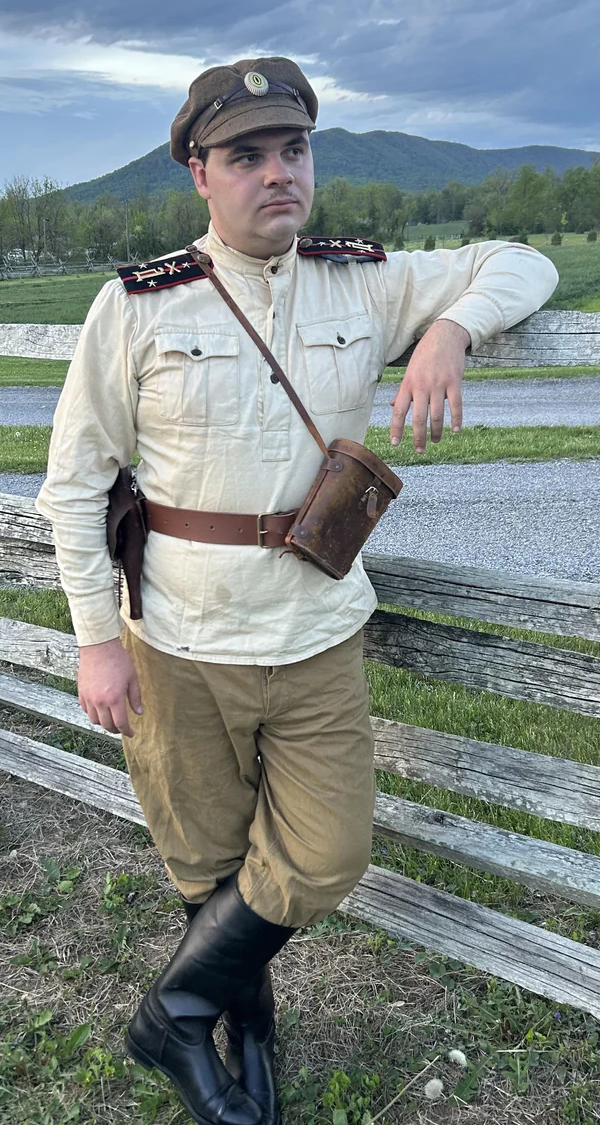
Re-enactor Markovite1919 from Reddit
The above impression of a Drozdovskiy artillery lieutenant is more what they probably looked like.
Flags
Most of these are unknown. The 2nd Horse-Mountain Battery flew a black-red-black guidon, but we don't know the proportions. As a horse battery, it was quite possibly in the style of Imperial cavalry squadron banners.

Brief History
Artillery
On their arrival at the Don the Drozdovtsy had a light artillery battery and howitzer divizion of ten light and two heavy guns. These units all served in the 3rd Division, under the command of Colonel Drozdovskiy.
On 4 April 1919 it expanded into the newly formed 3rd Artillery Brigade of the 3rd Division. Initially it had the following: 1st Divizion with the 1st (formerly 3rd Independent Drozdovskiy) and 2nd Light Batteries; 2nd Divizion with the 3rd and 4th Light Batteries (from the former Voronezh Corps); 4th Divizion with the 7th and 8th Light Howitzer Batteries (formerly 3rd Drozdovskiy Light Howitzer and Voronezh Corps respectively). In May and June 1919 it added a 3rd, 5th and 6th Batteries. Later it was to be four Divizions with 8 batteries. On 5 October 1919 it had 20 light guns and 6 howitzers.
With the transformation of the 3rd Infantry Division into the Drozdovskiy Division on 14 October 1919, it was renamed the Drozdovskiy Artillery Brigade on 22 October.
By 16 April 1920 it had only the 1st, 2nd and 4th Divizions. From May to August 1920 it lost 473 men.
Horse Artillery
A horse-mounted mountain battery was one of Colonel Drozdovskiy's first units in Romania. After it joined the Volunteer Army, it became part of the 3rd Infantry Division and participated in the 2nd Kuban Campaign as the Independent Horse-Mountain Platoon (from 5 October 1918 – Battery). At the end of 1918 and in the spring of 1919, it was assigned to the 1st Cavalry Regiment as the 3rd Independent Horse-Mountain Battery. From 4 April 1919, it was the Drozdovskiy Independent Horse-Mountain Battery.
On 27 May 1919, it became part of the 3rd Horse Artillery Divizion (alongside the 7th Horse Artillery Battery) in the 1st Cavalry Division and was renamed the 1st General Drozdovskiy Horse-Mountain Battery. Personnel were selected from the battery to form the 1st, 5th and 7th Horse Artillery Batteries.
This is the unit that Sergei Mamontov fought in. His memoirs give a full history of the unit from the 2nd Kuban Campaign. In them he notes that in 1919 the unit was able to fully equip with blue trousers, but they wore out and were replaced by English ones in the Crimea.
Engineers
During their entire existence the Drozdovskiy had their own Engineer Company. On 5 October 1919 it numbered 228 men.
I do not know the uniforms for this unit, but in general engineer uniforms were basically the same as artillery, replacing the crossed cannons with crossed tools on the shoulder-boards and with silver metal. Trousers may have been dark green.