
White Uniforms in General
The Whites wore Russian uniforms in the first period, usually WWI stocks, then increasingly Allied supplied material, mostly British. However supply was so poor that military items were mixed with whatever could be found, including significant items of civilian clothing. The key feature of the uniforms was that they were not uniform. If a White unit is shown looking very tidy it is usually either in new British uniforms or the photo was taken after the war, in the emigration period.
Nevertheless, the starting point for Russian Civil War uniforms is the Russian WWI variants.
Differences between Whites and Reds
As the Reds used the same uniform stocks the armies tended to look identical, other than senior ranking commanders. Each of the White armies had a sleeve marking to differentiate them, but it clear that it was not universally worn.
There are plenty of cases of Whites taking off their coloured shoulder-boards and then passing as Reds. Pavlov relates a case of veteran Markovtsy walking right up to some Soviets, having a conversation, then taking them prisoner. That should have been impossible if the Whites were wearing their arm chevrons and the Reds all wore the official rank markings on their sleeves. There are also recorded cases of Red commanders riding up to White soldiers and giving them orders ‐ clearly if they were wearing shoulder-boards they weren't particularly colourful ones.
Colour
In the RCW the White officers often wore items of the Imperial dress uniform, especially caps and trousers, when they could obtain them.
Items that were not from WWI stocks, and in particular the "coloured" regiments' uniforms, were totally dependent on what could be located. For example, the Drozdovskiy "raspberry", which was originally a dark pink, was particularly hard to find, so varied wildly from light pink through to pure red. The first shoulder-boards for the unit were made from fabric taken from sofas at a grand house.
Similarly, the black tunics and blouses of the coloured regiments were also difficult to obtain, since few had worn them previously, and were never particularly common as a result. White was actually more common, even among the Markovtsy.
Every now and again a unit would find the time or money to tidy up some aspect of their uniform. So Mamontov records his battery all having blue trousers for a while, and running into Drozdovtsy cavalry with red caps. The Alekseev Regiment briefly had most of the officers in the white tunics and coloured caps. However such as state of affairs did not last long, as all units had such a high turnover of men.
So, in practice it was only a tiny minority who wore the full coloured outfits, or even anything close to it.
Hats
Most Whites wore the traditional Russian service cap, in khaki. As the war dragged on, more and more wore the British service caps. If they could find or make them, officers wore the coloured versions for their unit.
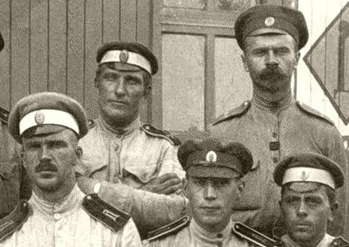 As in WWI, most men removed the stiffener from their caps. A few crushed the brim and pushed it right back in the "revolutionary" style, as was very common with the Reds, but most wore it much closer to regulations.
To the right we can see some reasonably senior officers (from the 2nd Drozdovskiy Rifle Regiment) showing what the caps tended to look like: from more or less regulation but with no stiffener, to pushed right back, with or without a crumpled front.
Various fur hats, especially the lightweight papakha, were worn as well, both by officers and men.
Helmets were rare, and tended to be "Adrians" when they did appear, although a few British style ones were seen.
Blouses and Tunics
As in WWI, most men in the ranks wore a gymnasërka, cut similarly to the traditional Russian peasant blouse. The exact shade of the "khaki" is not hugely important as the immense numbers produced in a hurry for WWI meant there was a huge variety. It tended to start quite a green shade, which often faded to more yellow, sometimes almost white. Most had no pockets on the chest.
The officers tunic (kittel) opened all the way down the front, had pockets on the chest and a higher collar. It was usually slightly darker and seems to have faded less. It did not have piping down the front, even if from a "coloured" regiment. However many officers wore a gymnasërka instead of the tunic, at least in the infantry (this habit may have arisen in WWI, when being noticeably an officer opened one up to extra attention from snipers etc).
It had became fashionable in WWI, especially with higher ranking officers, to wear a black tunic. This was never produced officially, so there were no stocks for the "coloured" regiments to use. Similarly, white tunics had been worn until just before WWI in the tropics, and they also made a comeback, presumably using old stocks. Black and white gymnasërka were also worn.
The blouse and tunic had large shoulder-boards on the shoulders. The RCW saw the return of the coloured versions, which the trench warfare of WWI had made impractical. Some were the large stiff ones of Imperial times, but many were much softer, and some were sewn onto the blouse. Markings might be done in paint or indelible pencil, it being hard to get the official materials. Many units had their own colours and markings as there was nobody to maintain any sort of official system.
The rank markings can be found here.
Trousers
The trousers tended to be slightly darker than the tops, and not fade so much. However pictures show a huge variety in actual shades of these too. I suspect civilian trousers made up a decent proportion.
The pre-war dress uniform had coloured trousers, dark green for foot and a variety for cavalry, though most hussars were red and most dragoons and lancers were dark blue. Individuals and units did try to revive those colours, especially the cavalry.
Greatcoats
In WWI the officer greatcoat was a light grey, with a hint of blue, while the other ranks wore a grey-green. However there was massive variation right from the start. In the civil war the firm distinction between ranks disappeared, as everyone wore whatever they could find.
The greatcoats were meant to have the shoulder-boards as well as unit tab markings on the collar. This was very often ignored as impractical.
Boots
Men tried to get the traditional Russian knee boots, but as the war progressed more and more resorted to low boots and puttees, especially of British origin. It is not uncommon to see men wearing trousers down to the boots as well, though obviously less practical in the wet and snow.
Russian peasants were used to going barefoot in good weather: it did not necessarily mean they had no boots. There were many complaints about the lack of proper shoes at the time, but photos rarely show men without decent boots. Sometimes homemade "bast" shoes are seen: while offensive to the upper classes, the peasants had worn them for centuries and they are quite practical.
It was rarely cold enough in the south to require the felt valenki boots that were seen in Siberia.