
83rd Samurskiy Infantry Regiment
The Samurskiy Regiment fought alongside the Drozdovtsy or Alekseevtsy for almost the whole war, so can be considered a "coloured" regiment.
Uniforms
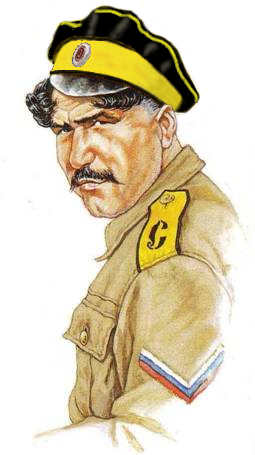
Note that the Osprey White Armies book is wrong about the cap of this unit. It was unusual for the cap band to not match the shoulder-board colours and there are strong indications that the colour has been reversed by accident. In any case, yellow caps would have been almost impossible to obtain. The version below has been corrected.
Yellow caps were only worn by the Commander-in-Chief's bodyguard unit (and they were closer to orange than pure yellow).
 |
 |
 |
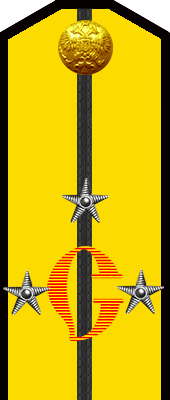 |
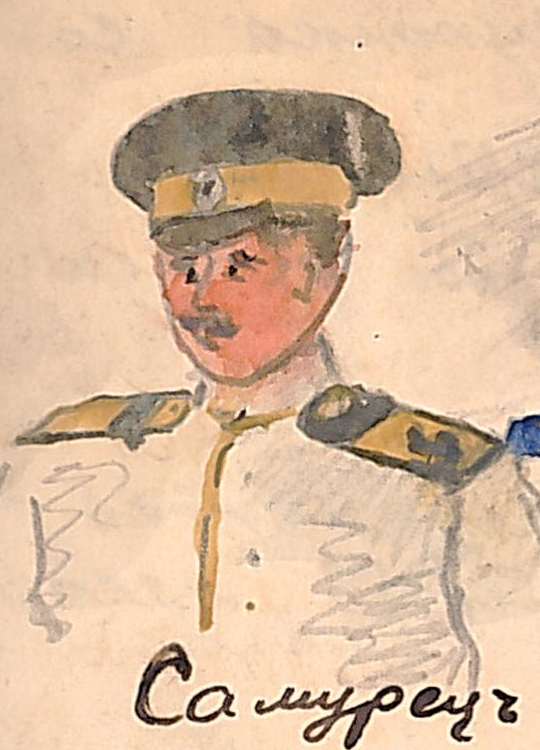
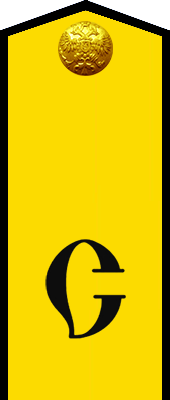
| Sudoplatov's sketch of a Samurskiy Officer | Private in Samurskiy coloured uniform with correct cap | Private's shoulder-boards, Samurskiy Regiment | Lieutenant's shoulder-boards, Samurskiy Regiment |
The dress Samurskiy cap had a black crown with yellow piping and a yellow hat-band with black piping.
Sudoplatov shows a dress tunic in white, with collar and opening piped yellow, which follows the pattern of the other coloured units. Linked with the Drozdovtsy in the early days, they may have avoided black.
The shoulder-boards were yellow, with black piping and detail. A Cyrillic letter "S" (which looks like a Latin "C") was added as cipher, in black for the ranks and in gold for officers.
I have seen no indication of preferred trouser colour.
Flags
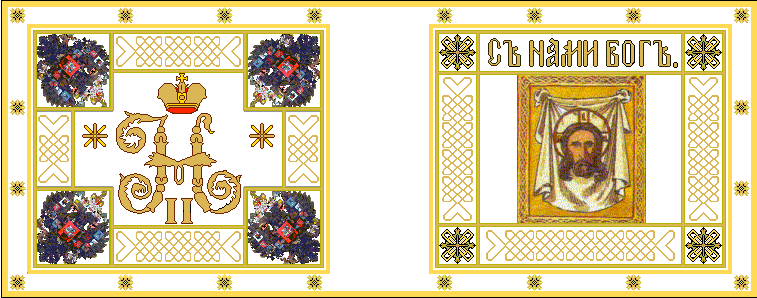
We know that the Samurksiy banner was kept by the officers who made it to the Volunteer Army. That is usually shown as a Nikolai:
<
However Vexillographia.ru indicates that the banner was of the previous issue, from 1879, so looking like this:
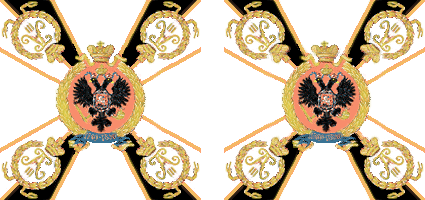
Brief History
On 21 June 1918, during the 2nd Kuban Campaign, the Volunteer Army's 3rd Division (which would become the Drozdovskiy Division) took a great mass of prisoners. A "soldier" battalion of three companies was formed from them, with officers taken from the 2nd Officers' Rifle Regiment (i.e. Drozdovtsy). Soon after, at the Battle of Tikhoretskaya, the new battalion showed itself to be excellent soldiers. A fourth company was added and the battalion was renamed the "1st Soldier Infantry Regiment" (all the previous ones being either Cossack or "Officer"). A little later 5th and 6th Companies were formed, still all from POWs.
On 14 August 1918 at Ust'-Labinskaya it merged with a battalion (180 men) commanded by former officers of the Imperial 83rd Samurskiy Infantry Regiment, which had retained its banner. The merged unit was named the Samurskiy Regiment as a result. It remained in the 3rd ID alongside the Drozdovtsy.
On 1 March 1919 it numbered 1,337 men and 32 MGs; on 20 June it had 591 men and 26 MGs; on 1 July it had 795 men and 26 MGs, and on 5 October 1919 it had 1,304 men and 26 MGs.
On 4 December 1919, it became part of the Alekseev Division (the Alekseevtsy being less numerous than the other coloured divisions, so this was a way to even out the divisions' sizes slightly).
On 1 April 1920 the Alekseev Brigade, as it was then, (640 infantry, 9 Lewis MGs and two British guns) landed at Kirillovka, intending to capture the bridge at Genichesk. The operation was a disaster and half the men and all the equipment was lost.
The now hugely depleted regiment was disbanded and used to replenish the Drozdovskiy Division. Officially it was called the 3rd Samurskiy Battalion of the 2nd General Drozdovskiy Rifle Regiment.
On 21 June 1920 the regiment was restored and placed in the 1st Brigade of the 6th Infantry Division.
The Samurskiy do not appear to ever had artillery in their name.