
Regular Artillery and Engineers
The regular artillery and engineers do not get much love in the sources, so this is pretty thin.
Uniforms
Artillery units used Russian guns as much as possible, but some of the later ones used British ones, since they were what was available. These units tended to be quite good, with a fair proportion of officers and with either WWI experience or British training.
The following assumes that the Imperial uniforms were used largely unchanged by the Whites in the south, which is probably true.
 |
 |
 |
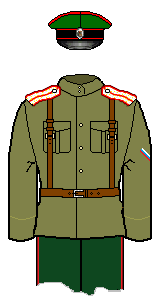 |
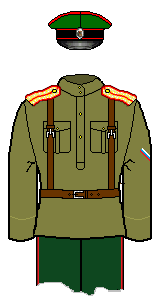
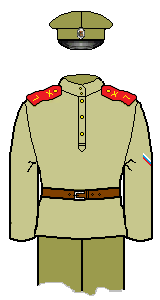
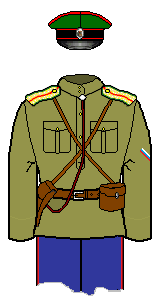
| Regular artillery officer | Regular artillery private | Horse artillery officer | Regular engineer officer |
Dress caps were dark green, with a red piping, and a black band, with red piping.
Shoulder-boards were plain red, with crossed cannons and their brigade number in yellow. Metal was gold. The crossed cannons and numbers for the officers were very hard to make out, being gold on gold. The khaki side was cannons and numbers in red.
Dress trousers with dark green with red piping.
Greatcoat tabs were black, with red piping.
Grenadier artillery differed only in having a grenade on the crossed cannons. In the RCW the unit had no number, being composite, so may have retained the "6" from their time as the 6th Artillery Brigade.
Horse and horse-mountain artillery differed by having dark green piping on their shoulder-boards, blue trousers (black for horse-mountain), dark green piping on their greatcoat tabs and light blue stencilling on the field shoulder-boards.
Engineers differed in having silver metal (including ciphers) and crossed tools instead of cannons. The dress shoulder-boards were still plain red with yellow numbers, but had brown ciphers on the khaki side of shoulder-boards (this may have changed to red during WWI though). I think they wore dark green trousers (but they have have been black or dark grey). Technical units in general were similar, but replaced the crossed tools (with lightning bolts for signallers, MGs on winged wheels for armoured cars etc).
Grenadier Engineers had a crowned "П" cipher instead of a number. Such a Monarchist symbol is unlikely to have survived in the AFSR though.
Unit Histories
Generally an infantry division had an artillery brigade with the same number, which was carried on the shoulder-boards. In the period before becoming brigades the divizion numbers were possibly used.
4th Artillery Brigade
Formed in the Armed Forces of South Russia on 4 April 1919 on the basis of the artillery of the 4th Infantry Division (presumably up to that point only being a divizion. It was based on the artillery of the Ekaterinoslav detachment, which arrived in Crimea at the end of December 1918. It included the 1st, 2nd, 3rd and 4th Divizions and a separate battery. On 27 August 1919 the 9th, 10th, 11th and 12th Batteries were formed and one added to each divizion. As of 20 September 1919 it had 26 light guns and 1 howitzer. On 1 October 1919, it had 1,503 personnel, including 373 officers and 13 non-commissioned officers.
It was disbanded on 14 December 1919 and its units sent to the newly formed 13th and 34th Infantry Divisions.
6th Artillery Brigade
Formed in the AFSR on 12 April 1919 as part of the 6th Infantry division. It had two divizions, each of two light batteries: the first having the 1st and 2nd Batteries, from the former Saratov Artillery Divizion, and the second the 3rd and Composite Grenadier Battery, from the Astrakhan Corps.
On 18 August the Combined Grenadier Battery became a separate divizion with the 5th and 6th Batteries. On 9 September 1919 it became the Composite Grenadier Artillery Brigade and added to the Composite Grenadier Division.
7th Artillery Brigade
Formed on 18 May 1919 from artillery units of the Odessa Rifle Brigade as part of the 7th Infantry Division. In the summer of 1919 the brigade had 69 officers and 103 soldiers (out of 723 men). It had the 1st, 2nd, 3rd (from 27 July 1919) and 4th Divisions, with the 5th, 6th and 8th Batteries being added in late July 1919.
On 2 March 1920 it was incorporated into the 4th Rifle Division and renamed the 4th Rifle Artillery Brigade.
13th Artillery Brigade
Formed in the Armed Forces of South Russia at the end of 1919 from the 4th Artillery Brigade (above) as part of the 13th Infantry Division. As of 16 April 1920 it had the 1st, 2nd and 4th Divizions.
34th Artillery Brigade
Formed in the Armed Forces of South Russia on 8 December 1919 as part of the 34th Infantry Division. On 16 April 1920 it had 1st, 2nd and 4th Divizions. On 1 August 1920, it had 51 officers and 797 soldiers with 18 guns and 19 machine guns.