
Markovtsy Infantry
Most of this comes from "The RCW 1917-1922: White Armies", by A. Deryabin, (AST), which is a Russian equivalent of the Osprey Men-At-Arms series.
Uniforms
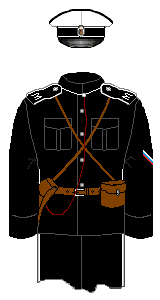
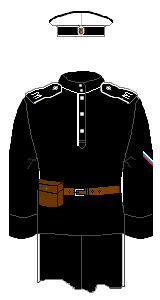
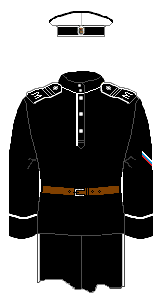
Exactness about the uniforms of the time is, naturally, impossible. However, there are a lot of representations of the Markov uniforms on the Internet that are drifting further and further away from the original sources. Most of what is portrayed is the dress uniform, but often for the wrong regiment: in particular, drawings said to be of the 1st Regiment show too much piping on the tunic or blouse.
 |
 |
 |
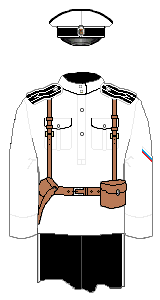 |
| Captain: 1st Officer General Markov Regiment | Private: 2nd Officer General Markov Regiment | Sergeant: 3rd Officer General Markov Regiment | Colonel: 1st Officer General Markov Regiment |
The cap had a white crown, piped black, and a black hat-band, piped white. Lower ranks were to wear one without a visor (called a beskozirka).
The tunic or blouse was black. The 1st Regiment had the bottom of the collar piped white. The 2nd Regiment added a piping down the blouse chest opening. The 3rd Regiment added piping on the cuffs. The pockets were sometimes piped, but it was not regulation. Period photographs show that the inverse – white with black piping – was almost as common in practice.
Trousers were black with a thin white stripe. Officers tried to get wide cavalry breeches.
 |
 |
 |
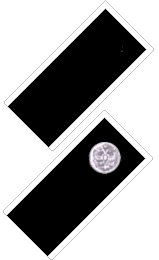 |
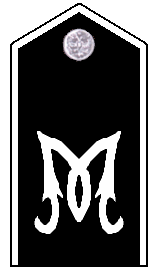
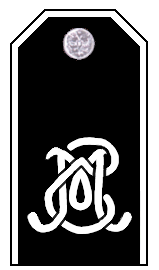
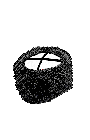
| Standard shoulder-board | General Markov Officer company shoulder-board | Official papakha | Greatcoat collar tabs |
After the death of General Markov, in early 1918, the regiment added a white "M" to the shoulder-boards, which were already black piped white. The first company, which was an officer company, added a stylised "ГМ" – which is "GM". The rank markings were based on the Imperial system, shown here, except officers did not use silver lace but retained the black cloth. The full range can be seen at the International Encyclopedia of Uniform Insignia site.
Formed in the Kuban, the Markov Regiment also had several items of Caucasian Cossack dress. The papakha fur hat was to be dark, with a white crown, with black cross. The bashlyk was black with a white tassel.
What they actually wore
While shown in so many uniform books and illustrations, the black dress uniform was barely ever worn at the front lines. Looking at period photos for 1919, even senior officers mostly are not in black, and do not have the white caps. What is seen instead is a variety of pieces of the uniform, including quite a few in white tunics. I have only seen one man in pretty much the full regulation, and he was an aide to General May-Maevskiy, so well away from the front lines.

Re-enactors with a 1919 Markov impression
The men mostly wore the same mix of old Tsarist and British uniforms that the rest of the AFSR wore, although they apparently avoided blue trousers. The sheer turnover of men – and that they were never withdrawn from combat for any length of time – prevented anything else.
They definitely wore the black shoulder-boards, though it is doubtful if the new recruits had them with nice piping and monograms. Hat bands would seem to be the next easiest to find, as shown by the 2nd Lieutenant above.
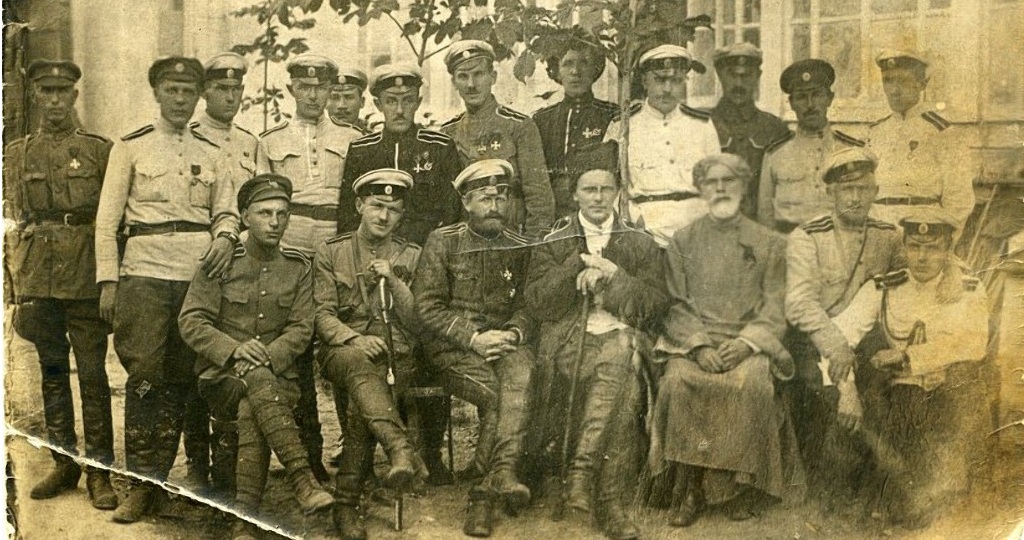
Senior Markovtsy with General Timanovskiy (centre, with fur hat), late 1919.
The photo above (from Wikipedia) is of long-time Markovtsy officers (and priest). It is the one I have found with the most dress hats, by quite some margin. Notice there is only one man in black and the variable or missing piping on the hats and tunics/blouses (I think only two or three of the tunics here are actually white, the others are just very faded khaki). The shoulder-boards are all Markov black, but are not monogrammed.
During this period the ranks were largely in British uniforms, although they disliked the British boots.
The only time the Markovtsy were able to rest for an extended time was on the Crimea in mid-1920, during which time they likely tidied up their uniforms. I have seen no photos from that period.
Photos of whole units regularly dressed are from the emigration period, in Gallipoli.
Flags
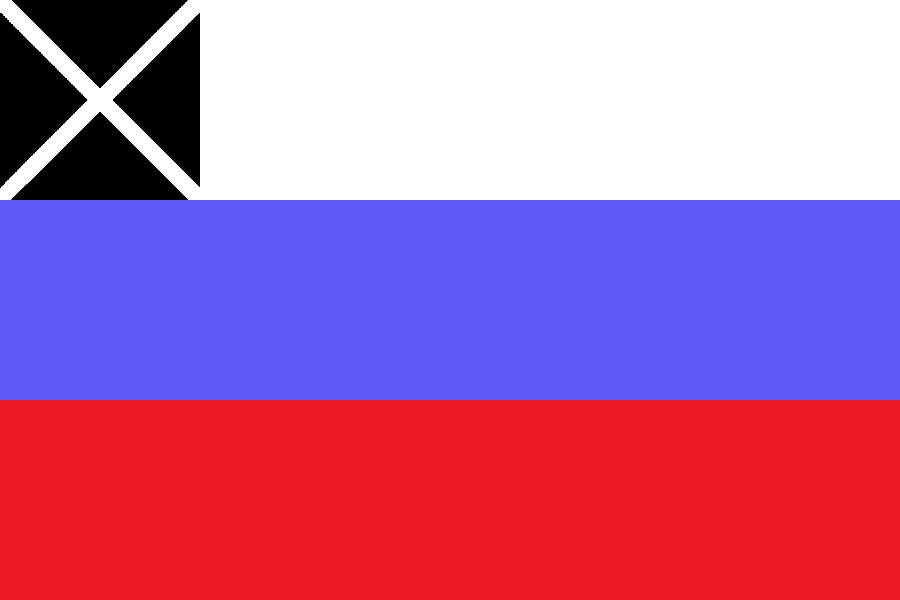
The flags are sourced from the pictures in Pavlov's history of the Markovtsy. He shows them as quite close to square. The 1st Regiment was a simple white St Andrews cross on black
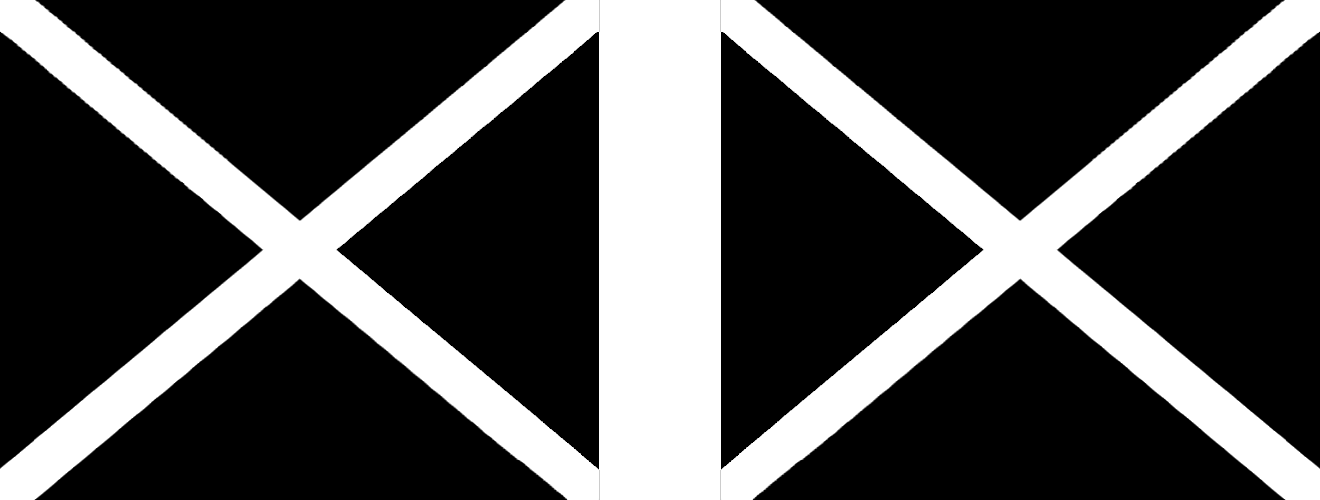
My drawing of the second has the lines somewhat thicker than Pavlov, but the cross disappears otherwise.
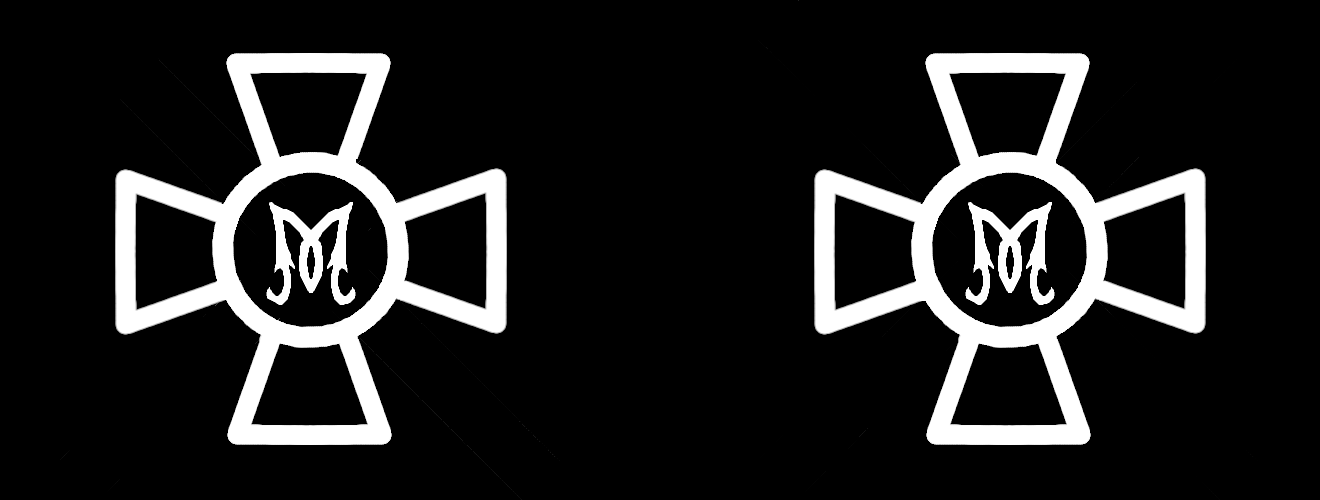
The 3rd Regiment was as the 1st with the addition of a thick white border (not thin piping, as is sometimes seen). The cross and border are shown on the thick side if anything.
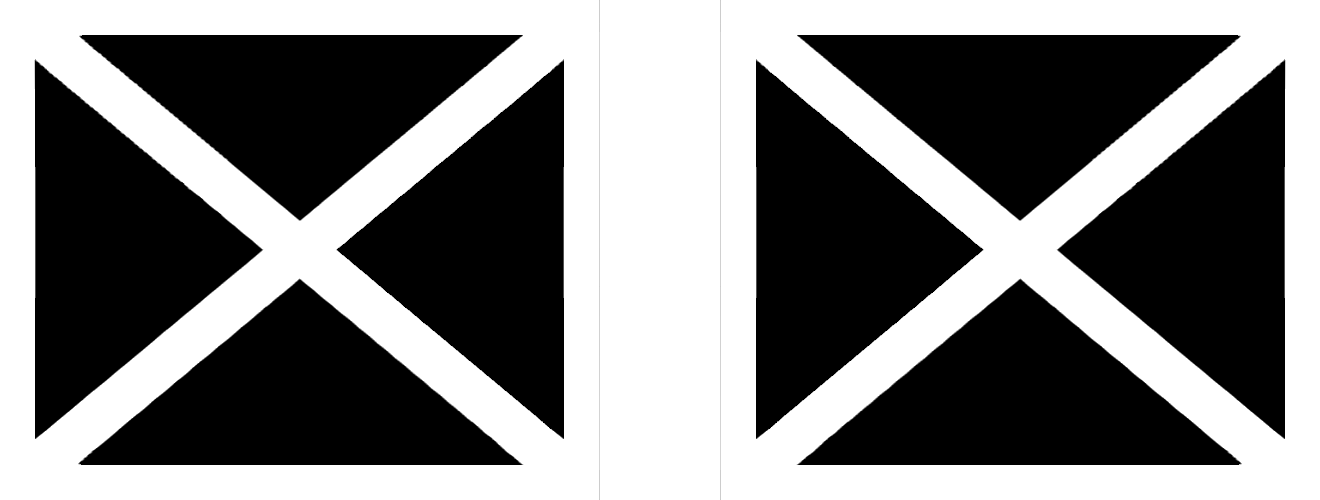
When the Markov Division was formed its flag was:
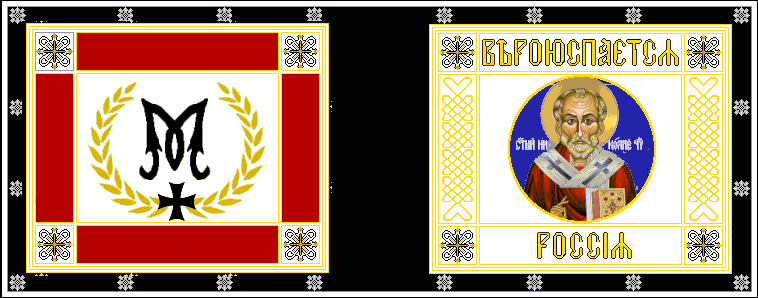
Baron Wrangel presented the reformed Markov Division in the Crimea with a "Nikolai" style flag in the middle of 1920. This was a ceremonial banner, not a battlefield one though. Other than parades, it would have spent its life inside a waterproof wrapper.
Brief History
1st Officer Regiment
The units that were to be named after General Markov date back to the beginning of the White Movement. The unit which would later be titled the 1st Officer General Markov Regiment was started on 17 November 1917 by General Alekseev in Novocherkassk from the first volunteers as the Composite Officer Company.
In early December 1917, after the Volunteer Army occupied Rostov there was a significant influx of volunteers which allowed the formation of the 2nd, 3rd, 4th and 5th Officer Companies. On 26 December the 5th Officer Company was renamed the 1st and was expanded into the 1st Officer Battalion. Soon after the 2nd and 3rd Officer Companies were also turned into battalions. At this point the unit was almost entirely former officers, cadets and volunteers. They were led by General Markov.
When the Volunteer Army was re-formed at the beginning of the 1st Kuban campaign in late February 1918, numerous small units were merged into larger formations. Among them was the Composite Officer Regiment: it was formed around the 1st, 2nd and 3rd Officer Battalions, into which were merged the Rostov Officer Company, the remnants of the 3rd Kiev Warrant Officer School, the Naval Company and the Shock Divizion of the Caucasian Cavalry Division.
During the 1st Kuban Campaign the regiment began to be called simply the Officer Regiment. From the middle of March 1918 it was part of the 1st Infantry Brigade. In June, with the reorganisation before the 2nd Kuban Campaign it was formally renamed the 1st Officer Regiment and became part of the 1st Infantry Division, still under General Markov.
After General Markov died from wounds received at Shablievskaya, the regiment was renamed the 1st Officer General Markov Regiment on 26 June 1918. It took part in the 2nd Kuban campaign and then in January-April 1919 it was invariably sent to the most difficult parts of the front in the Donbas, and suffered heavy losses.
2nd and 3rd Markov Regiments
With the beginning of the "March on Moscow" the Markov formations began to grow. At the beginning of August 1919 the 2nd Officer General Markov Regiment was formed in Kharkiv. In July a 4th Battalion had been added to the 1st Regiment, which included the training units, and that battalion became the 1st Battalion of the 2nd Officer General Markov Regiment. The 2nd Battalion was formed from part of the division's 1st Reserve Battalion. The 3rd Battalion was formed around a cadre from the 1st Regiment. The battalions were filled with both volunteers and conscripts.
In mid-October 1919 the 3rd Officer General Markov Regiment was officially formed in Kharkiv, although it had been forming since September on the basis of the 9th Officer Company of the 1st Regiment.
The increase in size could not be done without diluting the proportion of officers in the regiments. Some officers were recruited in the newly captured areas, often by conscription, but the ranks continued to be largely formed around volunteers, even if some of those men were formerly in the Red Army. The result was that the regiments retained much of their elite quality, even if not quite the level of the early version.
Markov Division
On 27 October 1919 the AFSR dissolved the 1st Infantry Division, which included all three Markov regiments, forming in its place the Kornilov Shock Division and Officer General Markov Infantry Division. In addition to the infantry regiments, the newly formed division included the General Markov Artillery Brigade (which had been formed from units of the 1st Artillery Brigade) and the 1st Independent General Markov Engineer Company. The division was part of the 1st Army Corps.
In spring-autumn 1919 reserve battalions were created for the Markov Division – one for the whole division and one for each regiment, which were used to replenish the combat units. These battalions were disbanded in early 1920.
The Markov Division was at the spearhead of the drive on Moscow and was placed in a difficult situation when Budenny's Cavalry Corps broke through at Voronezh. After a difficult retreat, on 31 December 1919 the division was badly defeated in the Donbas, at Alekseevo-Leonovo, losing a great many of its men. After regaining some of its strength, in January 1920 it was again defeated on 29 February near Olginskaya.
As a result, on 1 March 1920 the division was re-formed as the Officer General Markov Regiment. The artillery brigade was reduced to the Independent General Markov Artillery Divizion and the horse sotnias to the Horse Divizion. However, that situation did not last long, and even before their evacuation from Novorossiysk to the Crimea, on 26 March 1920, the units were restored to a division. In the Crimea it became part of the reformed 1st Army Corps.
On 11 May 1920, after General Wrangel renamed the AFSR the Russian Army, the division was renamed the General Markov Infantry Division, and in line with this the division's regiments and artillery brigade were similarly renamed.
In the summer of 1920 reserve battalions were once again created for the regiments and the division (the latter was intended to be deployed as the 4th Regiment, the formation of which was started in October).
As part of the 1st Army Corps, the Markov Division took part in the battles in Northern Taurida, the Trans-Dnieper Operation, and the last battles before the abandonment of the Crimea.
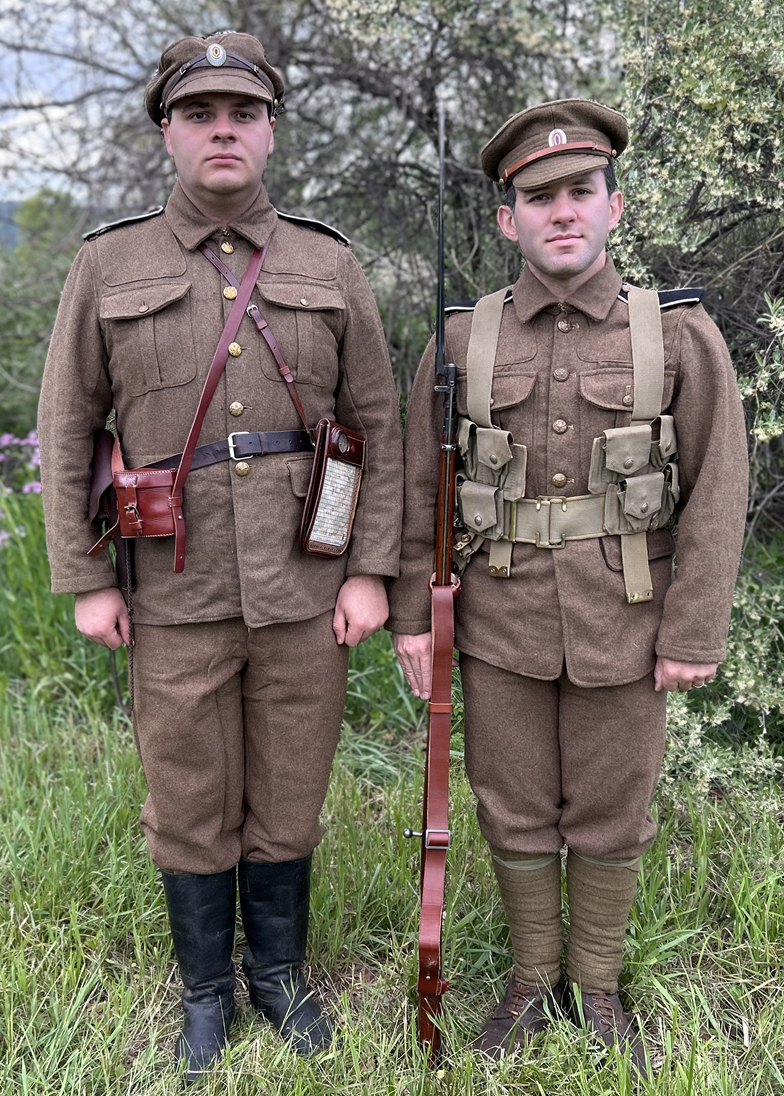 Impression of a 1919 Markov officer and ranker in English uniform (courtesy of Jackson Adams)