
Markov Artillery
Most of this comes from "The RCW 1917-1922: White Armies", by A. Deryabin, (AST), which is a Russian equivalent of the Osprey Men-At-Arms series.
Markov Artillery Uniforms
 |
 |
 |
|
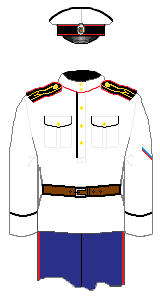
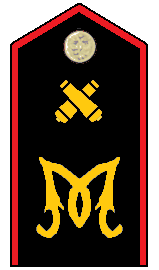
| Colonel: General Markov Artillery | Papakha | Shoulder-board |
The cap differed from the infantry by having red piping on the band. The fur hat was ideally to be white, of a Caucasian style, with black top and gold piping (orange for ranks).
The tunic or blouse was white. The collar was piped red, the opening, pockets and cuffs in black.
Trousers are said to be blue with a thin red stripe.
Shoulder-boards were black with red edges, gold details, with the standard crossed cannons. The 1st Battery had "GM", like the 1st Officer Company, and the rest had "M".
What They Actually Looked Like
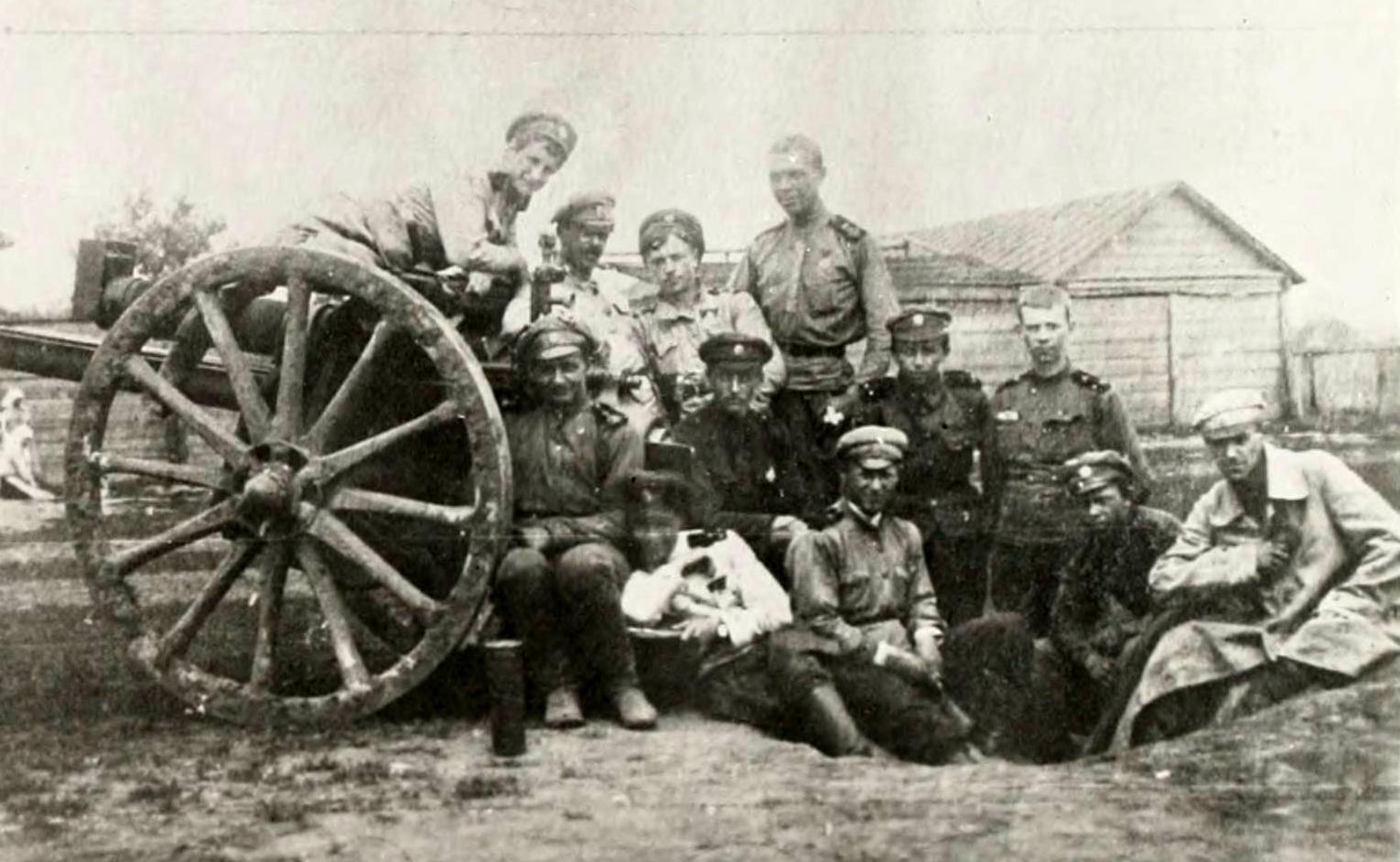
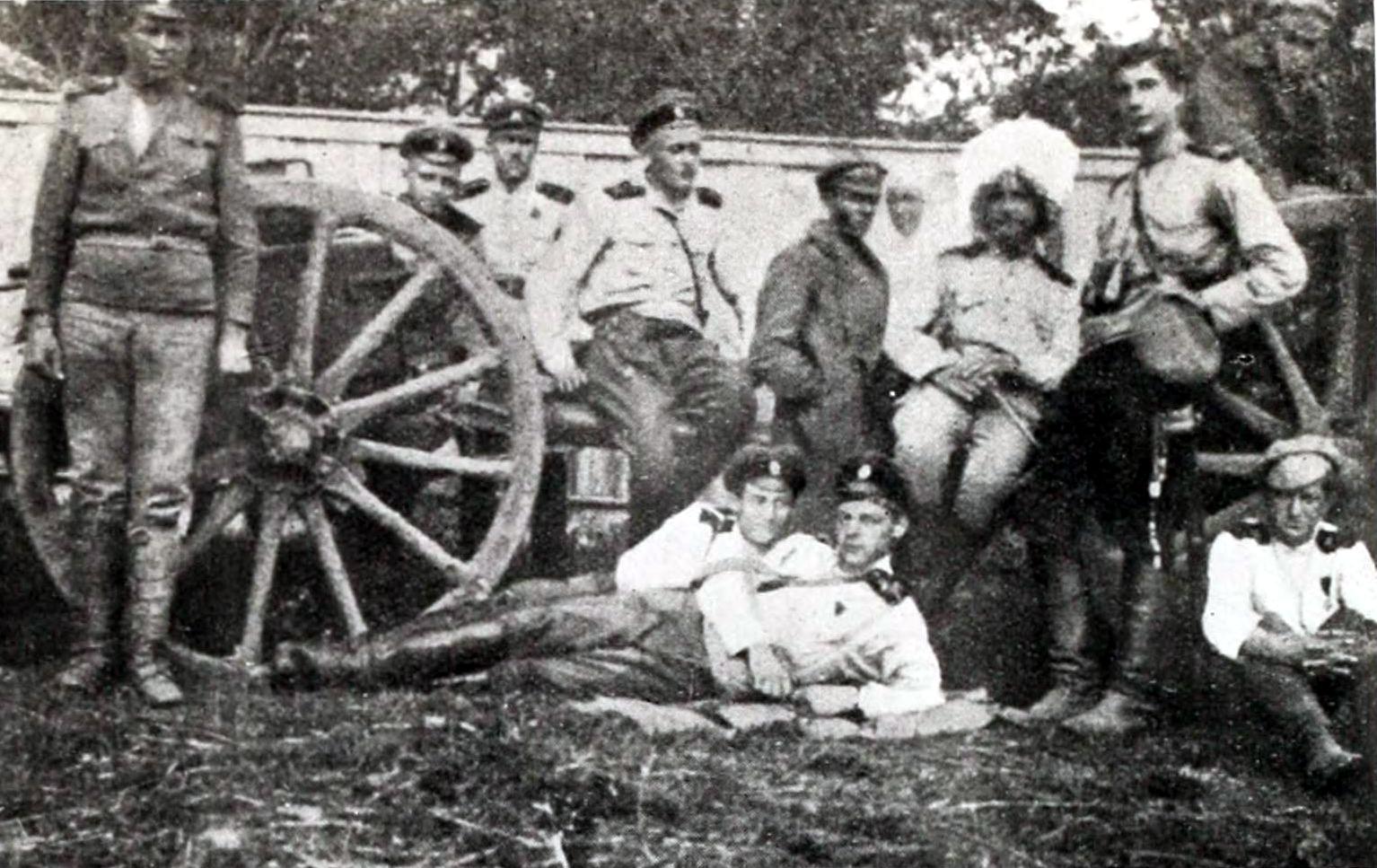
Officers of the 1st Battery, about the time of the 2nd Kuban Campaign
This is early on, so the men would not have had much time to find the coloured uniform. Nevertheless, some are in white tunics and many appear to have black hatbands, although without the white crowns – presumably just Imperial dress caps, which had black piped red hatbands with dark green crowns. Some of the shoulder-boards do appear to have the crossed cannons and some cipher, so it might be the "GM".
There is a picture of a battery in the late Crimea with most in white blouses, though I don't know if it is Markov.
Markov Artillery Flags
Most batteries probably flew a small standard, but we don't know them.
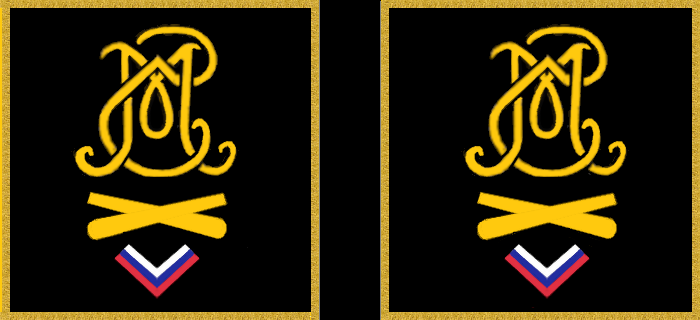
However, there is a flag in the Russian Army Museum which would appear to be for the 1st Battery, judging by the cipher. I have enlarged the detail a bit, to make it more visible. It was quite small, the size of a company level flag.
Brief History
1st Officer Battery
One of the first units of the Volunteer Army, formed in Novocherkassk. In mid-November 1917 the entire senior class of the Konstantinov Artillery School and several dozen cadets from the Mikhailov School, led by Staff Captain Shakoli, were able to make their way out of Petrograd in small groups, disguised as Cossacks who had completed propaganda courses in Petrograd.
On 19 November, upon the arrival of the first 100 cadets, the Mikhailov-Konstantinov Battery was formed. In the second half of November it numbered around 250 men (60 Mikhailovtsy and the rest Konstantinovtsy). In February 1918 it became known as the 1st Officer Battery. From the beginning of June 1918 it became part of the 1st Infantry Division, fighting alongside the 1st Officer Regiment, and served as the core of the future Markov Artillery Brigade.
1st Independent Light Artillery Divizion
Formed with a new second battery on 8 July 1918, still as part of the 1st Infantry Division. From 7 August 1918 the 1st Battery of the divizion was named the 1st General Markov Battery.
Over time other batteries were formed in the 1st Artillery Brigade, fighting alongside the Markov and Kornilov infantry in the 1st Division.
General Markov Artillery Brigade
Formed in the Armed Forces of South Russia on 15 October 1919, it was made up of the 1st, 2nd, 3rd, 4th, and 7th (Reserve) Batteries, with a total of 500 men. It grew to four divizions with the addition of the 7th and 8th Batteries. In practice its batteries were assigned separately to different units.
It was a very officer-heavy unit. In September 1920 it included 250 officers, with many of quite senior rank – even batteries were commanded by colonels.
It suffered heavy losses when the division was surrounded near Alekseevo-Leonovo on 18 December 1919, losing 12 of 13 guns there. Some of the other guns not in that village were lost soon afterwards. By 1 January 1920 only 365 men remained with 11 guns (including 33 officers and 150 soldiers).
After the second defeat of the Markov Division at Olginskaya and its reformation as a regiment, the artillery briefly became a divizion.
However a couple of months later, with its growth in the Crimea, it returned to a brigade and fought with the Markov Division in the northern Tauridia, Trans-Dnieper Operation and the defence of the Crimea.
1st Independent General Markov Engineer Company
Formed in the Volunteer Army in mid-March 1918 from the Technical Company as the 1st Engineer Company. On 8 December 1919 it was named after General Markov (though I think it had been informally been called that for a long time previously). It followed the Markov infantry as part of the 1st Brigade, 1st Infantry Division and then Markov Division.
On 5 October 1919, it had 563 personnel.
Engineers tended to wear uniforms only marginally different from the artillery, but silver metal and dark green [?] trousers.