
Kornilovtsy Infantry
Most of this comes from "The RCW 1917-1922: White Armies", by A. Deryabin, (AST), which is a Russian equivalent of the Osprey Men-At-Arms series.
Uniforms
There is no shortage of depictions of the Kornilov infantry on the internet, but they give a false impression of what the units actually looked like.
 |
 |
 |
|
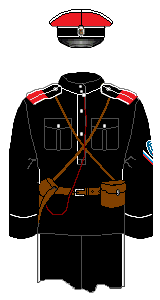
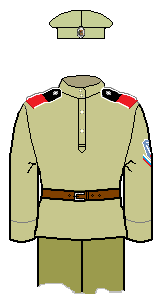
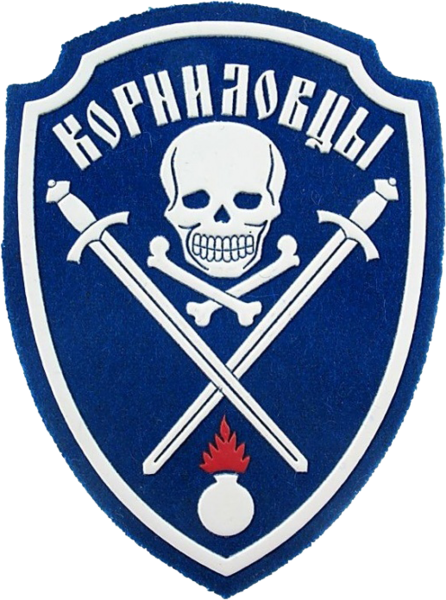
| Captain: General Kornilov Shock Regiment | Private: General Kornilov Shock Regiment | Sleeve emblem |
The dress cap had a red crown, piped white, and a black hat-band, piped white. Lower ranks often wore one without a visor (a beskozirka).
The tunic or blouse was ideally black, though many look quite faded in photographs. The bottom of the collar, cuffs and opening were piped white. The pockets were sometimes piped, but it was not regulation and seems rare. Period photographs show most men – even officers – wore khaki, but pretty much no-one had a white tunic or blouse. As well as the normal Volunteer army white-blue-red chevron many wore a specific Kornilov patch on their left arm (often quite high up).
Shoulder-boards were black on the top half and red underneath, piped white. The officer markings are in some dispute however: most coloured unit officers did not wear metal lace, as shown here, but it seems that many Kornilovtsy senior officers had the more traditional silver lace (as shown by the Osprey plate E5). Many men added a "K" in honour of Kornilov, but far from all.
Trousers were black with a thin white stripe, ideally riding breeches.
A few of the veterans wore the old red-black chevron from WWI on the right arm and used the skull cockade of the original unit, but they would have been a very small percentage even by the start of 1919.
What they actually wore
While shown in so many uniform books and illustrations, the black dress uniform was worn at the front by only a few officers. Levitov wrote about a parade in Kharkiv in mid 1919:
The parade of both Kornilov Regiments was commanded by the young commander of the 1st Kornilov Regiment, 25-year-old Colonel Skoblin. His regiment of around 2,000 bayonets made a powerful impression. The tanned, weathered faces of cheerful, confident youth breathed carelessness, courage and exuberant prowess. Some companies were dressed all in black with blue Kornilov emblems, the rest were full of uniforms of all colors.
The 2nd Regiment, standing nearby, was completely different. Its personnel had come from the training unit of the 1st Kornilov Regiment. There were no more than 100 original Kornilov officers in it, exclusively in command positions. They also had an officer company, which was 60% officers and volunteers. The remaining companies of the regiment were soldiers, made up of mobilised peasants of the southern provinces and "Makhnovist" prisoners. The entire 2nd Kornilov Regiment, thanks to the exceptional energy and enterprise of its commander, Captain Pashkevich (a career officer graduated in 1908), was dressed entirely in English uniforms with emblems sewn on them.
As it happens, we have photos of the 2nd Regiment from that parade.
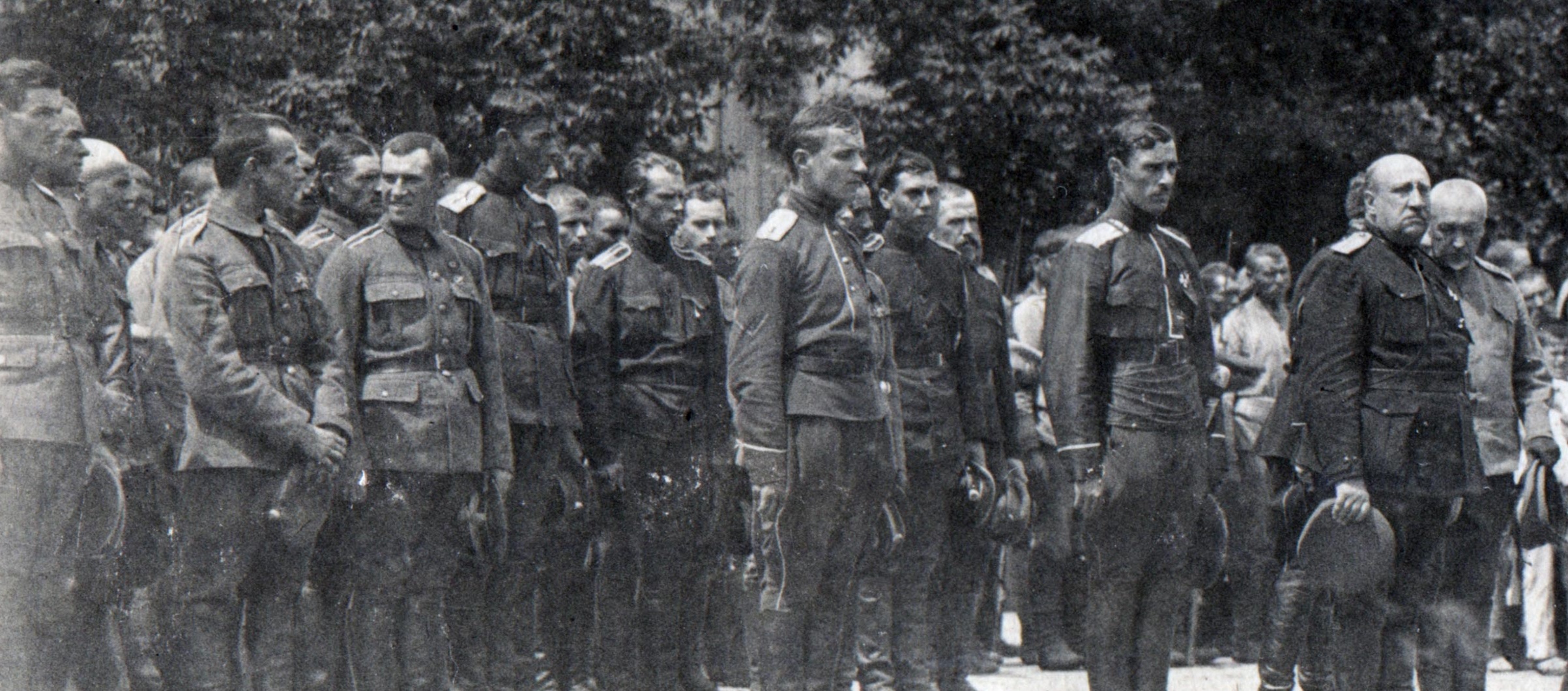
Kornilov officers at a parade in Kharkiv, mid-1919
The junior officers are in English uniforms, whereas the most senior ones have the black uniform with piping. The shoulder-boards for the junior officers appear red and black, but the senior ones appear to have metal.
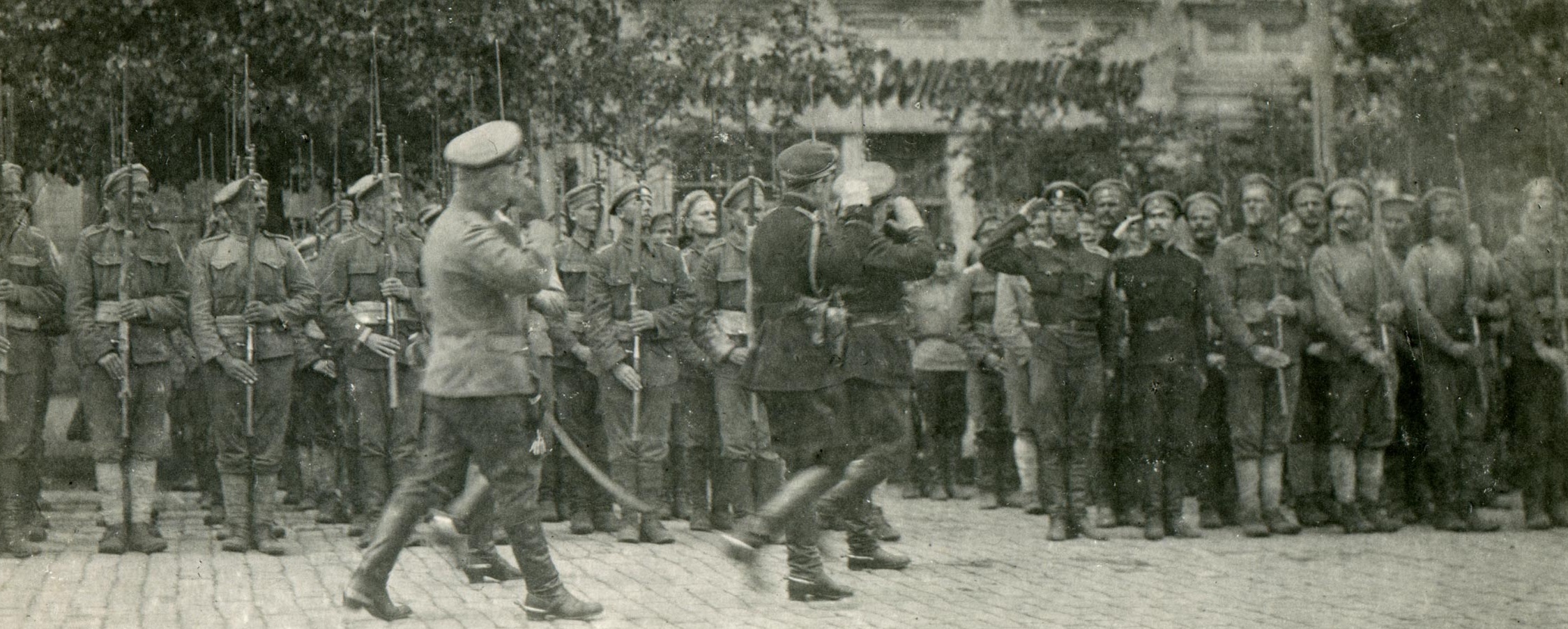
Kornilovtsy ranks at a parade in Kharkiv, mid-1919
The ranks are well turned out, especially by RCW standards, but are clearly mostly in British uniforms. Photos from the other angle show that many are wearing the sleeve patch.
Photos of whole units regularly dressed in black are from the emigration period, mostly in Gallipoli.
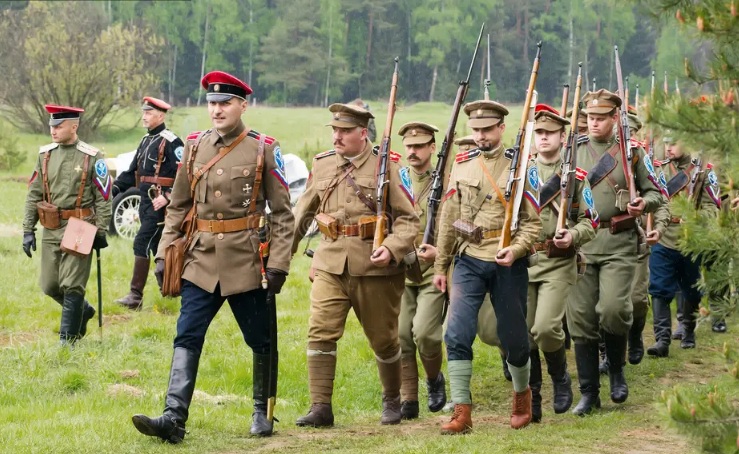
Kornilov re-enactors.
I suspect the photo above is approximately what they actually looked like, though the blues and reds are modern dyes, so too bright.
Infantry Flags
Regimental Flags
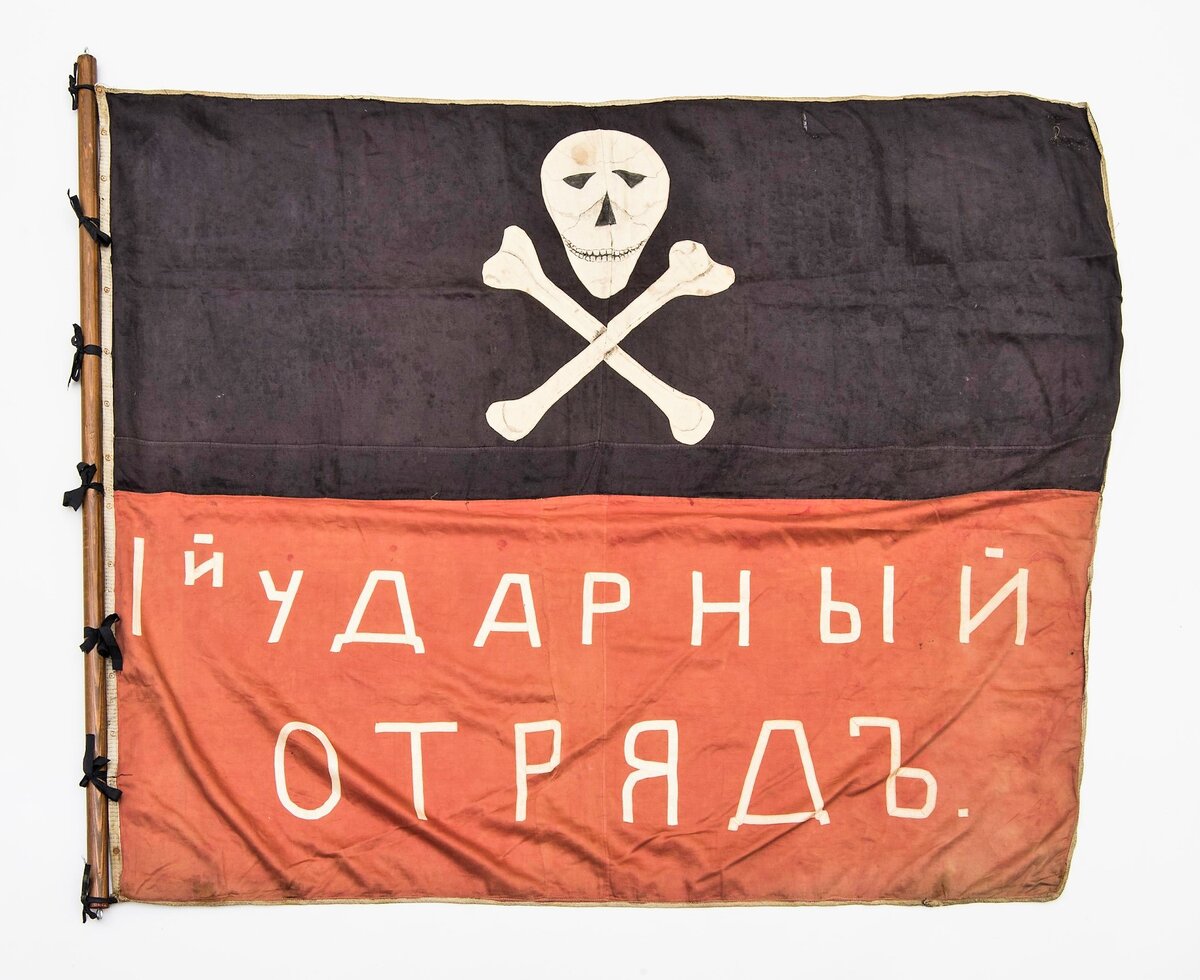
The main flag of the Kornilov Shock Regiment is a bit of an enigma. The WWI version, which can be seen in well attested photos, is a red upper half with "1st Shock Detachment" and a lower black half with a white skull and crossbones. Yet a flag from the Civil War has survived which is exactly the reverse. It is in the Hermitage Museum, shown below, although a bit faded now. Given that the shoulder-boards were black over red, and a surviving company flag is also that way round, I tend to prefer the second version for the RCW.
The other flag that was paraded in exile was the banner of the previous St George's Battalion from WWI. A lot of men from that unit made to south Russia, and ended up with the Kornilovtsy (as a similar "shock" regiment in origin) and it was a battalion flag in the Kornilov Regiment.
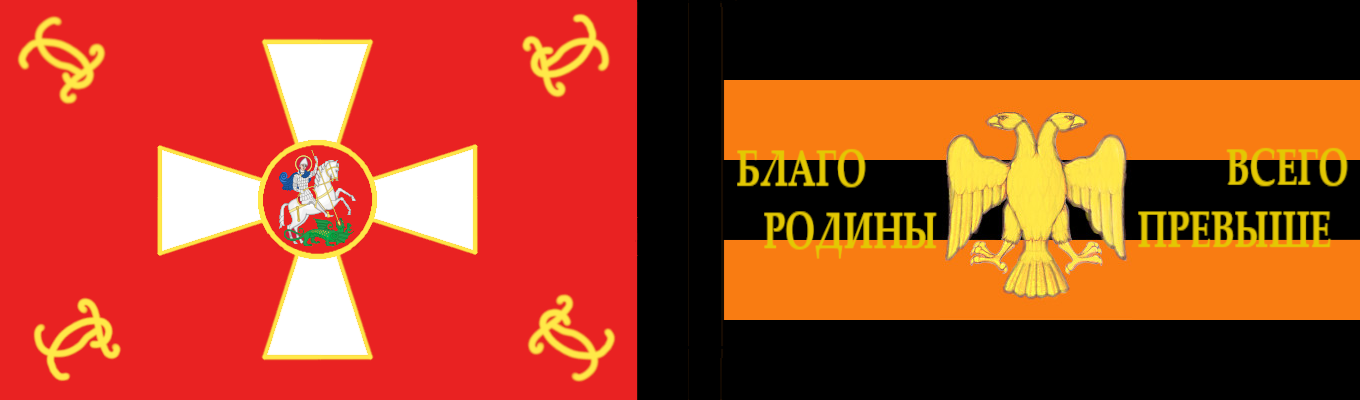
There is sometimes discussion about a Russian tricolour (in the modern white-blue-red, with or without "Fatherland" on it). That does not appear in exile, so was probably just a common flag of the times, rather than specifically Kornilovtsy. Any unit in the White Army might have carried such a flag.
Baron Wrangel issued a "Nikolai" style flag for the division in the Crimea. It was a parade flag only, and would have spent its life in a protective leather case. In the last days before the final evacuation he issued similar ones for the individual regiments.
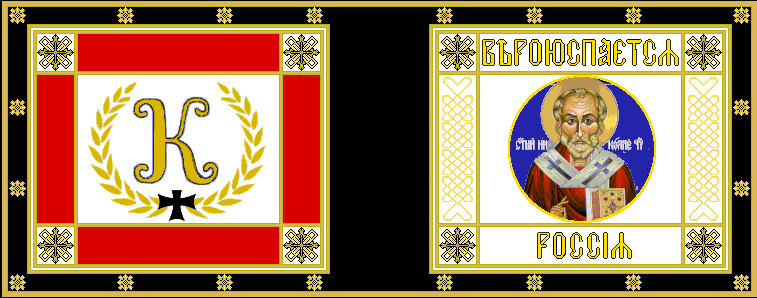
Towards the end the Kornilovtsy added the regimental banners of the 75th Sevastopol and 133rd Simferopol' Regiments when they absorbed them. They can be seen on the Regular Infantry page.
I have seen no information about any flag the 2nd and 3rd Shock Regiments may have had. They must have had them, and I cannot imagine they didn't go into emigration, yet they don't appear in any photos from that period.
Divisional Flag
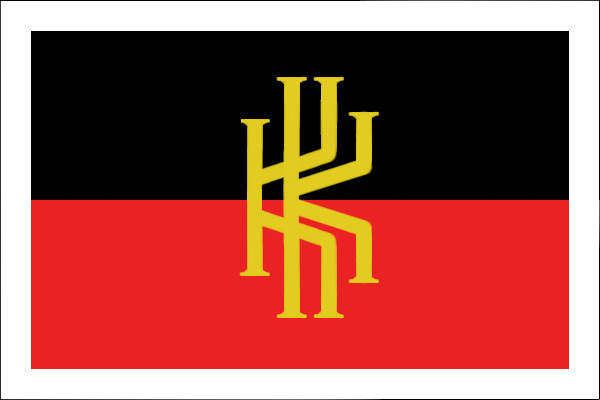
This turns up much later, in Paris, but presumably dates from the war period, as it is given pride of place at a major event (alongside the flags shown above). I do not know the reverse side, but it was presumably either the same or without the KK logo.
Lower Unit Flags
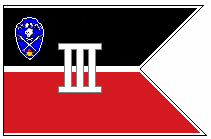
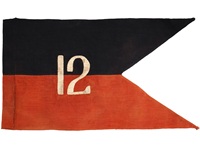
The Red Army museum had a flag that would appear to be a company flag, given its small size and shape, but I have seen it called a battalion flag.
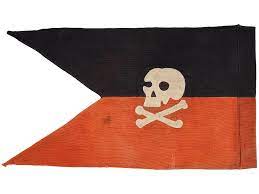
From time to time "authentic" material appears for sale, and this is purported to be a Kornilov flag. I doubt it is genuine, but it may be based off a real company flag.
Brief History
1st Kornilov Shock Regiment
The founding unit was created on 19 May 1917 from volunteers as the 1st Shock Detachment, which was transformed into a regiment (four battalions) on 1 August. In August 1917, it was renamed the Slavic Shock Regiment and incorporated into the Czechoslovak Corps. It took part in the October battles with the Bolsheviks in Kiev. After the Bolsheviks seized power, the regiment's officers made their way in groups to the Volunteer Army. The main group from the regiment arrived in Novocherkassk on 19 December 1917, and by 1 January 1918, 50 officers and around 500 soldiers had gathered.
During the reorganisation of the Volunteer Army at the beginning of the 1st Kuban Campaign in February 1917, the St. George Company and Colonel Simanovsky's Officer Detachment were incorporated into the regiment, giving it 1,220 men, a third of whom were officers.
From mid-March 1918 it was part of the 2nd Brigade, then from early June 1918 the 2nd Infantry Division, with which it participated in the Second Kuban Campaign. In January 1919 it was moved to the 1st Infantry Division. At that time it had 1,500 men. By September 1919 it had 2,900 with 120 MGs (three battalions, an officer company, a reconnaissance komand, and a communications squadron). On 5 October 1919 it had 945 men and 26 MGs.
From 12 July 1919, when the 2nd Regiment was formed, it was renamed the 1st Kornilov Shock Regiment.
At the forefront of the fighting, it suffered heavy losses. Of the 18 command personnel (up to company commanders) who took part in the 1st Kuban campaign, 13 were killed during the war. In total, it lost 2,229 men during that campaign. During the Second Kuban Campaign the regiment lost 2,693 men between the start of the campaign and 1 November 1918 (200% losses). From 1 January to 1 May 1919, in 57 battles in the Donbas, the regiment lost 3,300 men (from an average strength of 1,200 men), including 12 battalion commanders, 63 company commanders and 683 officers serving in the ranks. It lost 750 men in the fighting around Orël and Kromy. On 31 July 1920 it lost 61 officers and 130 soldiers in the battle for Kurkulak — a quarter of its strength. At the end of August, after the Kakhovka operation, 107 men remained in the regiment.
2nd Kornilov Shock Regiment
Formed in the AFSR on 12 July 1919 around officer of the 1st Regiment (most of the men were captured Makhnovists). It joined the 1st Infantry Division and then from 14 October 1919 the Kornilov Division.
In September 1919 it had 2,600 men with 85 MGs (an officer battalion of 700 men, three soldier battalions of 500 men each, a scout komand and a communications squadron). On 5 October 1919 it had 1,150 men and 30 MGs. On 21 June 1920, it had 8 staff officers, 253 senior officers and 793 soldiers, and on 9 July it had 349 officers and 1,018 soldiers. At the end of August, after the Kakhovka operation, 120 men remained.
The largest losses were in the September–October 1919 fighting around Orël and Kromy (1,560 men), on 17 June 1920 near B. Tokmak (57 officers and 62 soldiers), on 16 August near Verkhniye Serogoz (23 officers and 56 soldiers), on 21 August near Lyubimovka (111 officers and 327 soldiers), and the Kakhovka operation (800 men) and in the battle on 26 September on the Dnieper (68 people from the 1st Battalion were killed and 80 were captured).
3rd Kornilov Shock Regiment
Formed in the AFSR on 27 August 1919 in Kharkov, on the basis of the officer corps and training unit of the Kornilov Shock Regiment. It was in the 1st Infantry Division, then the Kornilov Division from 14 October 1919.
In the summer of 1919 among the 21 junior officers of the regiment, there were 14 ensigns, 3 second lieutenants, and 4 lieutenants. In September 1919 it had 1,900 men with 60 MGs (three battalions, an officer company, a reconnaissance komand, and a communications squadron). On 5 October 1919 it had 1,279 men and 17 MGs.
The regiment lost 646 men in the fighting around Orël and Kromy and was almost completely destroyed on 6 December 1919 in the forests northeast of Zmiiv (86 men remaining). On 29 July 1920 the regiment lost 180 men near Kurkulak, including 60 officers. At the end of August 1920, after the Kakhovka operation, 92 men remained in the regiment.
Kornilov Division
Formed on 14 October 1919 on the basis of the Kornilov elements of the 1st Infantry Division. It had the 1st, 2nd and 3rd Kornilov Regiments, a reserve battalion, the Independent General Kornilov Engineer Company and the General Kornilov Artillery Brigade. It was part of the 1st Army Corps. Soon afterwards a reserve regiment was formed and by at least January 1920 there were the General Kornilov and Muslim Mountain Horse Divizions.
The battalions and companies were usually commanded by junior officers. For example, there was not a single staff officer in the 2nd and 3rd Kornilov Regiments, formed in the summer of 1919. The junior officers of the companies (1–3 per company) were mainly ensigns.
At its peak in mid-September 1919, the division's regiments each had three battalions, an officer company, a foot scout komand and a communications squadron. The 1st Regiment had 2,900 men, the 2nd Regiment had 2,600 men (including 700 man officer battalion, instead of just a company), and the 3rd Regiment had 1,900 men. After the retreat, by January 1920 the total in all three regiments was 415 officers and 1,663 bayonets left. Its strength was increased in part by absorbing other units.
However, it was still one of the most reliable formations, usually operated in the principal direction, and suffered the heaviest losses. During the battles near B. Tokmak in the summer of 1920 it lost around 2,000 men. At the end of August 1920, after the division was almost completely wiped out on the wire barriers near Kakhovka, only 90-110 men remained in its regiments; in total, it lost about 3,200 men in seven major battles during the Kakhovka operation.
On 4 September 1920 it included the 1st, 2nd and 3rd Kornilov Shock Regiments, the Kornilov Artillery Brigade, a reserve battalion, the Independent General Kornilov Engineer Company and the Independent General Kornilov Horse Divizion. According to Soviet data, the units that withdrew to the Crimea at the end of October 1920 had 1,860 men and sabres.