
Composite Guards Infantry
These are little known units, at least in the context of the Russian Civil War, but can add some colour. The officers had previously been members of the Imperial Guard Regiments.
Dress Uniform
Life-Guard Regiments
 |
 |
 |
 |
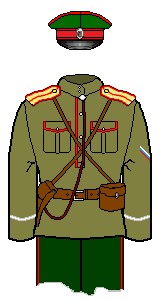
| Officer: parade dress Preobrazhenski Regiment |
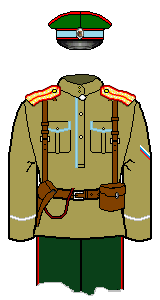
Officer: parade dress Semënovski Regiment |
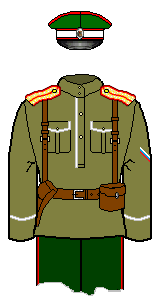
Officer: parade dress Izmailovski Regiment |
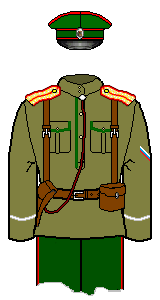
Officer: parade dress Jaeger Regiment |
These are the units, in order, of the Imperial 1st Guards Division. The division was recognised by its white cuff piping, with regimental differences in scarlet, light blue, white and dark green piped onto the tunic/blouse opening and on officer pockets. All buttons and metal were gold.
The 2nd Guards Division (Moskovski, Grenadier, Pavlovski and Finlandski Regiments) had the same, except all the cuffs were piped in red.
The 3rd Guards Division (Litovski, Kekholmski, St-Petersburgski and Volynski Regiments) had the same scheme, except 1) the cuffs and hat band were piped yellow, 2) buttons and metal were silver, and 3) in a break in the scheme the Litovski also had a yellow hatband, pocket piping and shirt front piping.
The greatcoat tabs were the colours and piping of the hatbands.
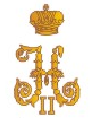
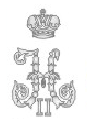
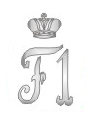
The dress shoulder-boards were plain red for all units, except that many had special ciphers for the 1st Companies only.
 |
 |
 |
 |
| All the 1st Division, Grenadiers, Pavlovski | Volynski | Kekholmski | St-Petersburgski |
Rifle Regiments
 |
 |
 |
 |
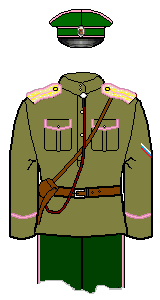
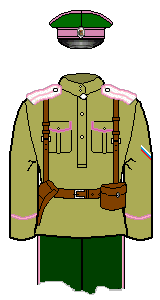
| Officer: 1st Guard Rifle Regiment |
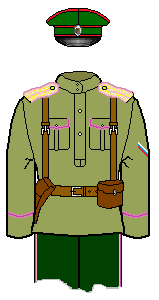
Officer: 3rd Guard Rifle Regiment |
Officer: 4th Guard Rifle Regiment |
Greatcoat tabs, 1st to 4th Guard Rifle Regiments |
The Guard Rifles, like all rifle units, had "raspberry as their distinguishing colour. That was a pink, in practice, although often quite a dark pink.
The 2nd Guard Regiment differed from the 1st only that its metal was silver, not gold. The 3rd also had silver metal, but a different cap band. The 4th was like the 1st, except the hat had red piping.
Shoulder-boards were solid raspberry. The 1st Companies of the 1st and 4th had gold "N II" ciphers (like the 1st Division) and the 1st Company of the 3rd had a silver "N II".
Field Uniform
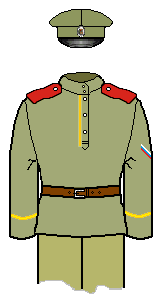
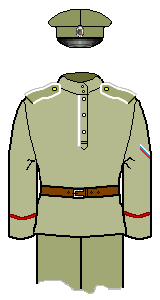
The field uniform did away with the coloured caps and trousers, but the blouses still had lace down the blouse front and on the cuffs (I have also seen reference to the top of the collar being piped in the regimental colour).
Apparently officers were fond of their coloured caps, and had tried to keep them in the field even in WWI, since the green was fairly inconspicuous anyway.
 |
 |
 |
 |
| Private: field dress Litovski Regiment |
Private: field dress St-Petersburgski Regiment |
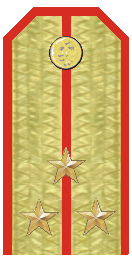
Dress shoulder-boards: Poruchik (Lieutenant) |
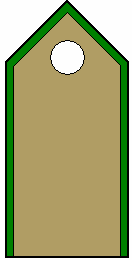
Field shoulder-boards: Volynski Regiment |
The field shoulder-boards were khaki, with the divisional colour piping: scarlet for the first (yellow for Litovski), then light blue, white and green. Given that it was likely easier to find plain red cloth than piped khaki, I suspect that they generally went with the dress uniform red/raspberry in the Russian Civil War. Note that the guards did not have ciphers on their shoulder-boards.
Flags
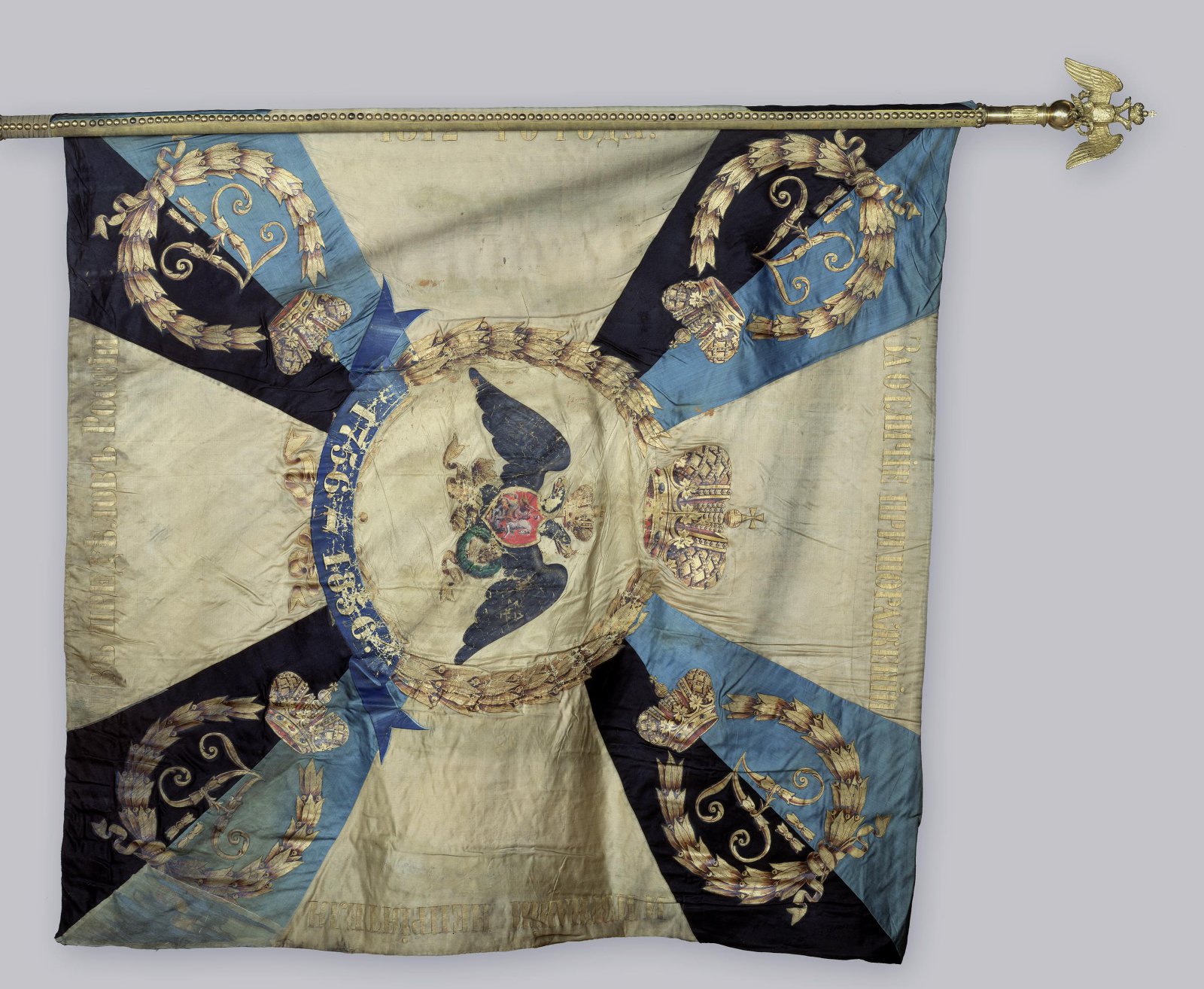
Only a few of the precious regimental banners made it to the Whites, and I wonder whether they would have been risked on the front lines. In any case, many of the Guards regiments had very old flags that were in tatters by this period.
One that did make it to the Volunteer Army was that of the Grenadier Regiment. It is unclear if it was used for the company/battalion representing that regiment, or adopted by the entire composite regiment.
For myself, to represent the fact the guard units were quite old-fashioned and often used eagles for their sub-unit banners, I went with small simplified imperial eagle flags for the composite regiments, trimmed in the division colours.
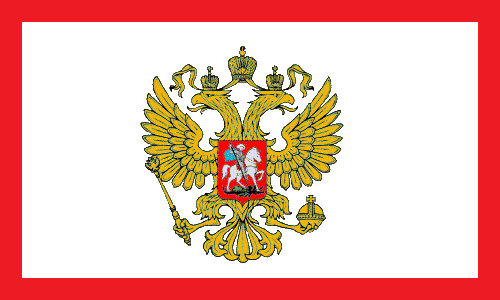
For the HQ, I preferred the monarchist colours, with an "LG" (ЛГ) standing for Life-Guard:
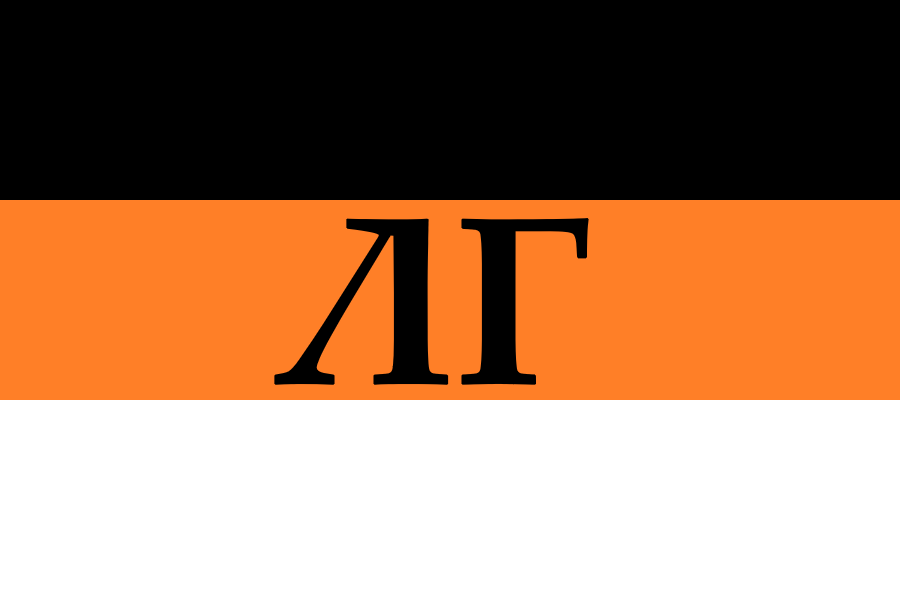
Of course, since the Russians didn't think the front of a flag needed to match the reverse, you could back one with the other.
An interesting photo has survived from very early in the emigration period of former guards at a dinner. On the wall are what would seem to be battalion and company flags. These had no system, so any relevent imagery would be suitable.
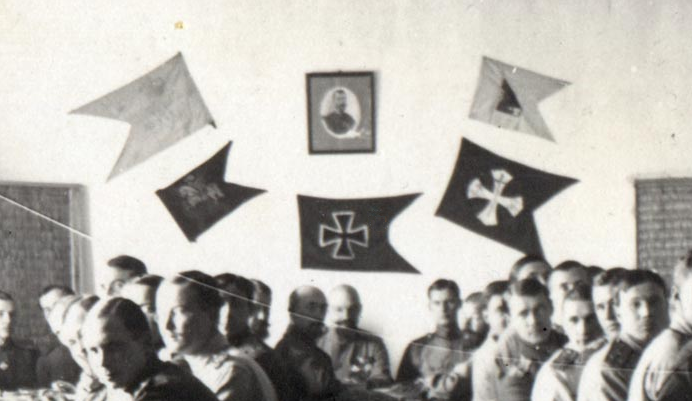
I can't make it out, but the upper left apparently is a crowned "PP" (ПП) with dates visible, so possibly the Preobrazhenskiy Regiment, the next is clearly a picture of St. George, so is likely the Moscow Regiment, the next two are apparently for the Jaeger Regiment and the Semenovskiy Regiment. The last is impossible to even guess.
History of the Composite Guards Infantry
None of these units seem to have been elite. While the officers were former guards, the men were not volunteers and there do not seem to have been any "officer" companies (indeed they did not have many officers at all). At one point a unit of former guardsmen arrived from France, only to immediately desert.
Composite Guards Regiment
Also known as the Composite Guards Infantry Regiment. Officially formed on 19 October 1918 around guards officers who had been serving in the Markov Regiment. (Originally all guards officers were placed in it, but the cavalry were soon made into a separate formation.) It was placed in the 2nd Brigade of the 1st Division. It started with approximately 1,000 bayonets in five companies and took heavily casualties in the 2nd Kuban Campaign, especially around Armavir.
In January 1919 it was placed in the 5th Infantry Division. From 6 March to July was in General Vinogradov's detachment. At the end of May 1919 it had about 2,180 men.
Composite Guards Brigade
Formed in the AFSR on 8 August 1919 by expanding the guards regiment.
The 1st Composite Guards Regiment was based around men from the Imperial 1st and 2nd Guards Divisions (less the Finlandski, who served with the Don Host, see here). It had three battalions (Grenadier, Pavlovski, and Composite), each three companies, each 40–60 men and 4–5 officers; independent Preobrazhenski and Moskovski Companies; MG komand; and mounted scout komand.
The 2nd Composite Guards Regiment was based around men from the Imperial 3rd and Guards Rifle Divisions. It had three battalions (1st, 2nd and Rifle) each of four companies (with two companies from each of the guards and one from each of the rifle regiments); three mounted and one foot scout komands; two MG komands; and a trench-gun team.
This unit fought in the western Ukraine in the drive on Moscow.
Composite Guards Infantry Division
Formed on 12 October 1919 from the Composite Guards Brigade.
It had four regiments in two brigades (Composite Regiments of the 1st, 2nd, 3rd and Rifle Guards Infantry Divisions); Reserve Battalion; Composite Guards Artillery Brigade; Independent Artillery Divizion; Independent Guards Heavy Howitzer Battery; and Independent Guards Engineer Company.
The Composite Regiment of the 1st Guards Infantry Division started with a battalion for each of the regiments in the Imperial 1st Guards Division. Each battalion had three companies (around 50 men, 4-5 officers). By 24 November it was down to four companies (Preobrazhenski, Semenovskiy and two Jaeger) with only 180 bayonets, 35 sabres and 12 MGs. By 3 December it was one company, a MG komand and a horse squadron (80 sabres, 10 officers, 4 MGs). By January 1920 it was back to three companies, with 100 bayonets, 80 sabres and 10 MGs.
The Composite Regiment of the 2nd Guards Infantry Division started with a battalion representing each of the Moskovski, Grenadier and Pavlovski Regiments of the Imperial Army. By January 1920 it was down to a composite battalion of 200 bayonets, 80 sabres and 20 MGs.
The Composite Regiment of the 3rd Guards Infantry Division started with a battalion for each of the regiments in the Imperial 3rd Guards Division. By 9 November it had been reduced to only 71 men. In December its few remaining men went into the units of the 1st Brigade.
The Composite Regiment of the Guards Rifle Division started with two battalions. By 9 November it had been reduced to one battalion. When it reached Odessa it had 200 bayonets, in four companies, and eight komands
The division's brigades and units had acted independently in Kiev and Chernigov areas. Only with the collapse of the front was it united in January 1920 in the Odessa area. On 20 January 1920 it had about 1,000 men.
Independent Guards Brigade
Reformed on 2 March 1920 from the much reduced Guards Division, in the 2nd Army Corps. It was made up of Composite 1st and 2nd Guards Regiments and Guards Artillery Divizion (three batteries).
Isolated in the western Ukraine by the collapse of the front, it took part in General Bredov's march to Poland, where it was interned.
Composite Guards Infantry Regiment
In August 1920 about 400 guardsmen who had arrived in the Crimea from Poland became the basis for this regiment adding some 200 men from the Guards battalion of the 136th Taganrog Infantry Regiment, so uniting all the Guards infantry cadres. By the summer of 1920 it had 1,200 bayonets in four battalions (one representing each division in the Imperial army). It had about 400 men at emigration.
Other Guard Infantry Units
The Finlandski Guard Regiment formed a separate unit in the Don Army. Their history can be found here.
The Reserve Regiment of the Semënovski Guards Regiment, based in Petrograd, deserted en masse to Iudenich in 1919. However, having served for so long under the Reds first, it is doubtful that many of the coloured features made it into the NorthWestern Army.
A Guards Reserve Brigade was formed in the AFSR in the summer of 1919, intended to replenish the units of the Composite Guards Infantry Division. By the end of winter 1919 there were more than 8,000 men, but due to a lack of uniforms and equipment it couldn't complete its tasks. It was formed from conscripts from Khorolsk, Lubensk and Piryatinsk counties. It fell apart at the end of November 1919
Colonel Petrovskiy's Guards Detachment was formed from guards who were in Crimea after the collapse of the White front in 1920. It included the Guards Cavalry Divizion and infantry units formed from the Reserve Guards Battalion. In January-April 1920 it defended the Perekop Isthmus, suffering heavy losses.
The 1st Composite Guards Battalion was formed in the AFSR in the summer of 1919, after the capture of Konstantinograd (Krasnograd, Berestin). It had one company representing each of the Preobrazhenski, Semënovski, Izmailovski and Jaeger Regiments (around 70 men, with 4 –5 officers each) and a mounted scout komand (Jaeger Regiment). It protected the Poltava — Lozovaya rail line. On 10 September 1919 it was subordinated to the commander of the 2nd Composite Guards Regiment and participated in the battles for Chernigov. On 8 November 1919 it was disbanded and the companies transferred to the battalions of their regiments in the main division.
A Guards Battalion was formed in the 136th Taganrog Infantry Regiment from the various scattered guardsmen left in the AFSR upon retiring to the Crimea. The men were later transferred to the Composite Guards Infantry Regiment after the remnants of the former division were repatriated from Poland.