
Composite Guards Cavalry
These are little known units, but can add some colour. The officers had previously been member of the Imperial Guards Regiments.
Note that despite the names "Hussar", "Cuirassier" etc, all these units fought as front rank lancers and rear rank sabres.
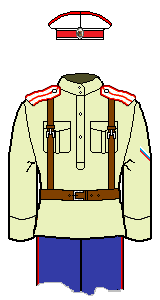
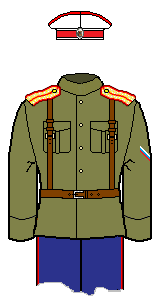
Dress Uniform
 |
 |
 |
 |
| Officer: dress uniform Life-Guard Cavalier |
Officer: dress uniform Life-Guard Horse |
Officer: dress uniform His Majesties' Cuirassiers |
Officer: dress uniform Her Majesties' Cuirassiers |
 |
 |
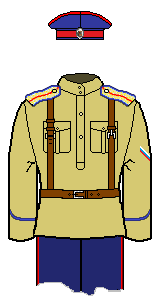 |
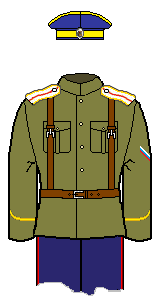 |
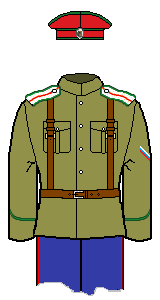
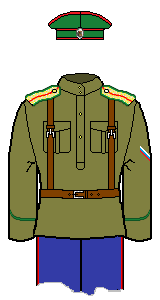
| Officer: dress uniform Life-Guard Dragoons |
Officer: dress uniform Horse-Grenadiers |
Officer: dress uniform Her Majesties' Lancers |
Officer: dress uniform His Majesties' Lancers |
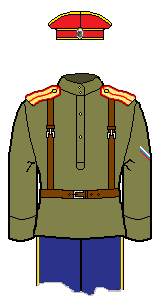 |
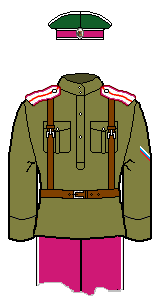 |
 |
|
| Officer: dress uniform Life-Guard Hussars |
Officer: dress uniform Grodno Hussars |
Trooper: field uniform Life-Guard Dragoons |
There are some disputes among my sources as to the exact colours of the cuff piping: I have gone with the normal scheme (matching to shoulder-board piping) in such instances. The other ranks (not officers) of the two Hussar units may have had dark green cuff piping. Note the cuff piping was not flat, but peaked.
The cavalry seems to have been better dressed than the infantry in practice during the civil war. Given the difficulty in hiding men on horses carrying lances, the addition of coloured caps is unlikely to have severely affected battlefield performance.
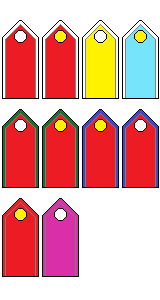 |
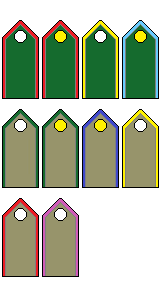 |
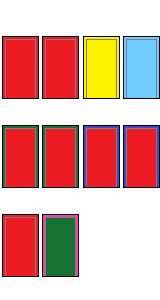 |
|
| Dress shoulder-boards for other ranks | Field shoulder-boards for other ranks | Greatcoat tabs |
Shoulder-boards, as usual for guards, had no ciphers, although a few of the first squadrons did have an "N II" monogram.
Flags
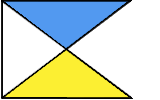
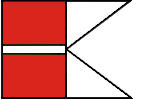
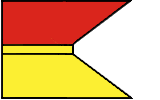
The lance pennons are below, although pennons were not used in combat they could make useful squadron flags. Some squadrons in the Imperial Army definitely flew the lance pennons with their number in them (e.g. the 5th and 6th Squadrons of the Cavalier Regiment had a "5" and "6" in the white triangle). Other squadron flags were more or less random, such as the 3rd Squadron of the Cavalier Regiment having a red rectangle with a white Maltese cross and the 4th Squadron having a white rectangle with a red double-headed eagle.
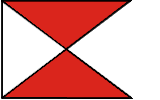 |
 |
 |
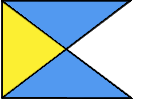 |
| Life-Guard Cavalier | Life-Guard Horse | His Majesties' Cuirassiers | Her Majesties' Cuirassiers |
 |
 |
 |
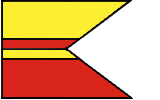 |
| Life-Guard Dragoons | Horse-Grenadiers | Her Majesties' Lancers | His Majesties' Lancers |
 |
 |
 |
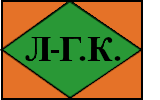 |
| Life-Guard Hussars | Grodno Hussars | Composite Guard Cuirassier Regiment | Composite Guard Cavalry Regiment |
I do not know the regimental flags, but I have added ones based on the Imperial model for a regiment, using the appropriate guards colours.
Guards Cavalry Units
The Tsar's Cossack Guards who went on to form units in the RCW did so in their hosts, and are described here for the Don and here for the Kuban.
Composite Regiment of the Guards Cuirassier Division
Was formed in the AFSR on 26 February 1919 around cadres from the Imperial Army Guards Cuirassiers. It was placed in the 5th Infantry Division of the Crimean-Azov Army (which included the composite guards infantry unit). On 22 May 1919 it was placed in the Independent Cavalry Brigade, as part of the 3rd Army Corps.
In June 1919 it was renamed the 1st Guards Composite Cuirassier Regiment and placed in the 1st Brigade of the 2nd Cavalry Division. In July 1919 it included two squadrons each from the Cavalier, Life-Guard Horse, His Majesty's Cuirassier, and Her Majesty's Cuirassier Regiments. On 5 October 1919 it had 478 sabres and 28 guns.
From 19 November 1919 it was part of the 1st Cavalry Division. By 15 December 1919 it had lost 90% of its composition, being left with a few dozen sabres, and was merged into the Composite Guards Cavalry Regiment.
Composite Regiment of the Guards Cavalry Division
Formed at the beginning of 1919 in the AFSR from former guards cavalry (except those in the cuirassier regiments).
In June 1919 it was renamed the 2nd Composite Guards Cavalry Regiment. It was placed in the 1st Brigade of the 2nd Cavalry Division. In July 1919 included two squadrons each from His Majesty's Lancers, Horse Grenadiers and the Life Guards Dragoon Regiments. On 5 October 1919 it had 258 sabres, 19 bayonets and 13 MGs.
From 19 November 1919 it was part of the 1st Cavalry Division. By 15 December 1919 it had only a few dozen sabres, and was merged into the Composite Guards Cavalry Regiment.
Composite Guards Cavalry Regiment
Officially formed on 15 December 1919 from men in the much reduced 1st Guards Composite Cuirassier Regiment and the 2nd Guards Composite Cavalry Regiment. It was placed in the 1st Cavalry Division. Originally four squadrons, in January 1920 it added squadrons from the Guards Hussar and Her Majesties' Lancer Regiments (till then in the Composite Mountain Division), and a squadron representing the Grodno Hussars (from the Composite Hussar Regiment). By this point it included all guards cavalry officer cadres.
It was then placed in the Composite Cavalry Brigade. It played a role in the defeat of the Red's 1st Horse Army near Rostov on 6-8 January and fought at Egorlykskaya. It was then part of the reformed 1st Cavalry Division.
Guards Cavalry Regiment.
Formed on 16 April in the Russian Army in Crimea after the withdrawal from the Kuban. It started with eight squadrons: one from each of the Imperial Guards Regiments. It was part of the 1st Cavalry Division. In October 1920 it had only 200 sabres and 1 MG.
Other Guards Cavalry Units
Small pockets of Guards cavalry appeared in the early Volunteer Army until slowly merged into the composite regiments listed above. Likewise after the collapse in early 1920 there were various small groups before Wrangel merged them all. Tracking them is a bit of a nightmare.
The Composite Hussar Regiment was formed in May 1919. It included a squadron of the Life Guards Grodno Hussar Regiment until it was transferred to the Composite Guards Cavalry Regiment in January 1920.
The Composite Mountain Division included the revived Life Guards Hussar Regiment and Her Majesties' Lancer Regiment until they was transferred to the Composite Guards Cavalry Regiment in January 1920.
Former Life Dragoons officers collected in November 1918 as the officers for a mounted scouts komand for the Composite Guards [Infantry] Regiment. In March 1919 they went to the Reserve Cavalry Regiment. From spring 1919 it served in the Composite Dragoon Divizion. In April 1919 it was a squadron of 90 men, its core made up of German colonists. It then went to the 2nd Composite Guards Cavalry Regiment.
The Guards Cavalry Divizion was formed in Crimea from the ranks of the guards cavalry who were there (mainly Life Dragoons). It was part of Colonel Petrovskiy's Guards Detachment. It was almost wiped out at Perekop in the night of 3 April 1920.