
Composite Guards Artillery
Both the revived Guards infantry and cavalry regiments were accompanied by their matching artillery units.
Guards Artillery Uniforms
In the Imperial army each of the Guards Divisions had an associated Artillery Brigade. Many of those men made it to the Volunteer Army.
 |
 |
 |
 |
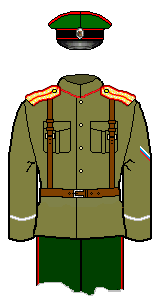
| Officer: dress uniform 1st Artillery Brigade |
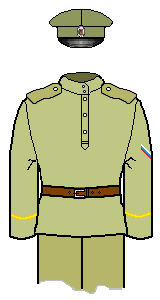
Private: field dress 3rd Artillery Brigade |
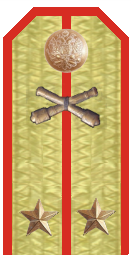
Shoulder-boards: 2nd Lieutenant of Artillery |
Shoulder-boards: Gunner |
The dress uniform officers of the 1st Brigade is shown above. The cap was dark green, piped red, with a black hatband, piped red. Cuffs were piped white. Trousers were green, striped in red.
The uniform for the 2nd, 3rd and Rifle Artillery Brigades differed only that the cuff lace was dark green, yellow and raspberry respectively. Note that the collar was piped in red for all.
Dress shoulder-boards were plain red, with gold metal. Field shoulder-boards were either plain khaki (or possibly piped red, my sources disagree). It is unclear whether artillery had the usual crossed cannons, but it seems no guards units had unit ciphers (it was a feature of the Imperial Russian Army that the older and senior units often had less distinguishing features).
Greatcoat tabs were black, with piping in white, dark green, yellow and raspberry.
Artillery officers often wore the green trousers in the field, even in WWI.
Other units
The Imperial Guards Howitzer Divizion, which presumably formed the basis for the AFSR Guards heavy artillery, wore the same uniforms as field artillery, but with light blue cuff lace.
Imperial Guards Horse Artillery wore the same uniforms as the field artillery except 1) their cuffs were piped black (and pointed), 2) their tunic pockets were piped red, and 3) dress shoulder-boards were still plain red, but the khaki version was piped black. Greatcoat tabs were black, piped dark green. Trousers may have been black. Metal was gold.
History of the Guards Artillery
Early on in the Volunteer Army former guards sought to form units together. As a result, several batteries were formed in the early VA with largely guards officers.
For example the 1st Gun of the 3rd Battery of the 1st Independent Light Artillery Divizion was formed around men of the Life Guard 1st Artillery Brigade. That slowly expanded by recruiting other guardsmen until it become the Independent Divizion of the 1st Artillery Brigade, with 8 guns and a horse-machine gun komand (16 machine gunners and 40 horse scouts).
The Life Guard 2nd Artillery Brigade likewise started as a single gun at about the same time, and also grew to Divizion by the end of 1918, but the 3rd Artillery Brigade and Rifle Artillery Brigade took a lot longer to assemble decent numbers.
Composite Guards Artillery Brigade
This was formed on 1 January 1, 1919 around such batteries and with an influx of new recruits.
By 22 May 1919 it included the 1st (1st and 2nd Batteries), 2nd (3rd and 4th) and 4th (7th and the 8th) Divizions. By 1 July it had added the 3rd Divizion (5th and 6th Batteries). By later that month it had 20 guns.
On 1 August 1919 it added a 9th Battery (in the 1st Divizion), and on 1 October the 10th Battery (in the 2nd Divizion).
It was part of the 5th ID, alongside the Composite Guards Regiment, and then formed part of the Composite Guards Infantry Division.
In September — October 1919 the divizions operated independently, assigned to various guards brigades/regiments.
It was disbanded on 17 April 1920 and the remaining three batteries placed in a Guards Artillery Divizion, attached to the newly formed Independent Guards Brigade.
Few Guards artillery appear to have made it to the Crimea. However, the 2nd Independent Heavy Artillery Divizion was formed around guardsmen of the Imperial 2nd Guards Artillery Brigade.
Independent Guards Heavy Howitzer Battery
Appears in the formation of the Guards Infantry Division.
Independent Divizion of Guards Horse Artillery
Formed as a battery at the beginning of 1919. At the end of June 1919 it added a second battery. It seems to have dissolved some time in early 1920.
It served alongside the revived Guards Cavalry units throughout its existence.
Independent Guards Engineer Company
Formed in the Volunteer Army at the end 1918. From May to September 1919 it was in the 5th Infantry Division (alongside other guards units). It was then part of the Guards Infantry Division. On 7 September 1919 it had 23 officers and 416 soldiers.
The Imperial Guards Sapper Battalion wore effectively artillery uniforms, but with silver metal and white cuff lace. They may have worn black trousers in the field. Their greatcoat tabs were black piped white.
Imperial Guard Horse Sappers were the same as Guards Horse Artillery but with white metal.