
Drozdovtsy Infantry
The Drozdovtsy were different from the other "coloured" units in that they turned up a basically fully formed division, rather than growing out of much smaller units.
Most of the uniform information comes from "The RCW 1917-1922: White Armies", by A. Deryabin, (AST), which is a Russian equivalent of the Osprey Men-At-Arms series.
Infantry Uniforms
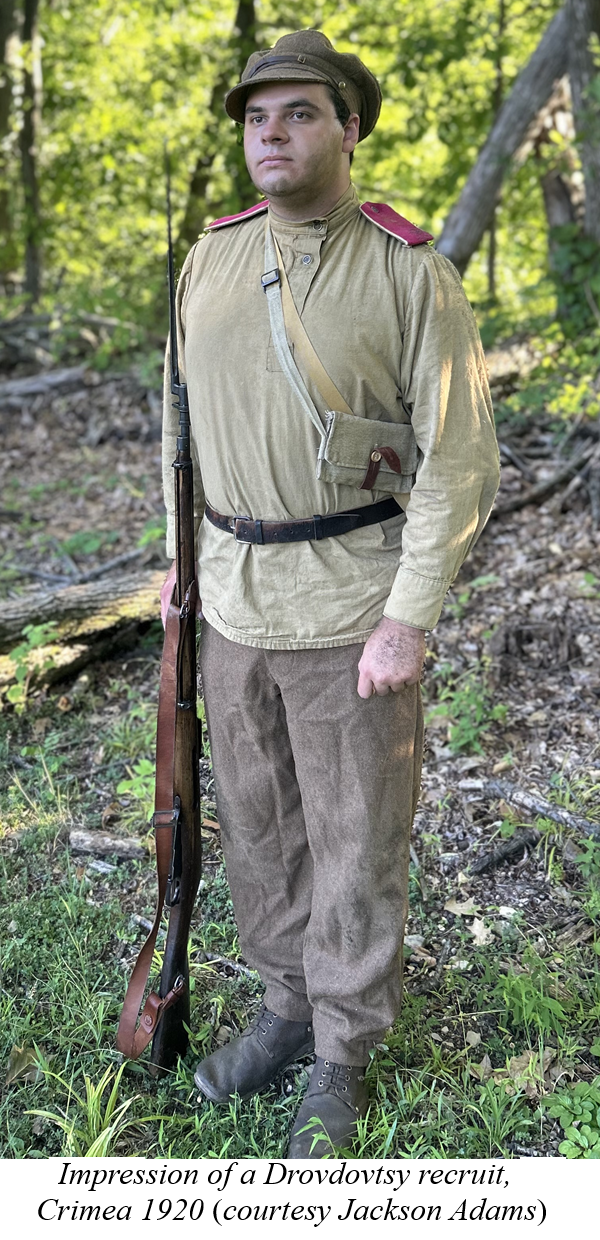
The Drozdovtsy arrived at the Volunteer Army in May 1918 in very good shape. While the Volunteer Army was incredibly poorly clothed at the time, the Drozdovtsy were in pretty much ideal Russian WWI clothing. The infantry were enrolled into the VA as the 2nd Officer Rifle Regiment, and that pretty much determined their distinction colour to be "raspberry" – the traditional colour for rifle units.
However, it was only in early 1919 that the unit started to adopt the more "coloured" items.
 |
 |
 |
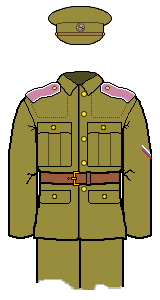 |
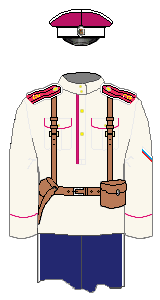
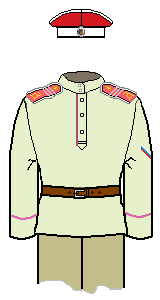
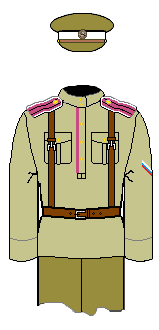
| Captain: General Drozdovskiy Rifle Regiment | Sergeant: General Drozdovskiy Rifle Regiment | Captain: General Drozdovskiy Rifle Regiment | Private: General Drozdovskiy Rifle Regiment |
The shade of raspberry shown in illustrations varies considerably. It is likely that in practice that many men had to settle for the much more available red.
The cap had a raspberry crown, piped white, and a white hat-band, piped black. Lower ranks were to wear one without a visor (a beskozirka), as had become the style for the other coloured regiments.
The tunic or blouse was khaki, although often very faded in practice. They seem to have mostly avoided the trend for black or white tops. Officialy, the opening, cuffs and pockets were piped raspberry.
Trousers were black or dark blue with a thin white stripe.
Greatcoat tabs were white piped raspberry.
The shoulder-boards were raspberry, piped white and black and black detail. After the death of Colonel Drozdovskiy, in early 1919, the regiment added a yellow/gold "D" to the shoulder-boards. The rank markings were based on the Imperial system, shown here, but officers did not have gold but retained the raspberry cloth. The full range can be seen at the International Encyclopedia of Uniform Insignia site. It's doubtful that many men could get such difficult colours and insignia.
The third and fourth uniforms shown above are for 1919, when the unit wore a lot of British uniforms.

Staff of the 2nd Officer Drozdovskiy Rifle Regiment outside their HQ train
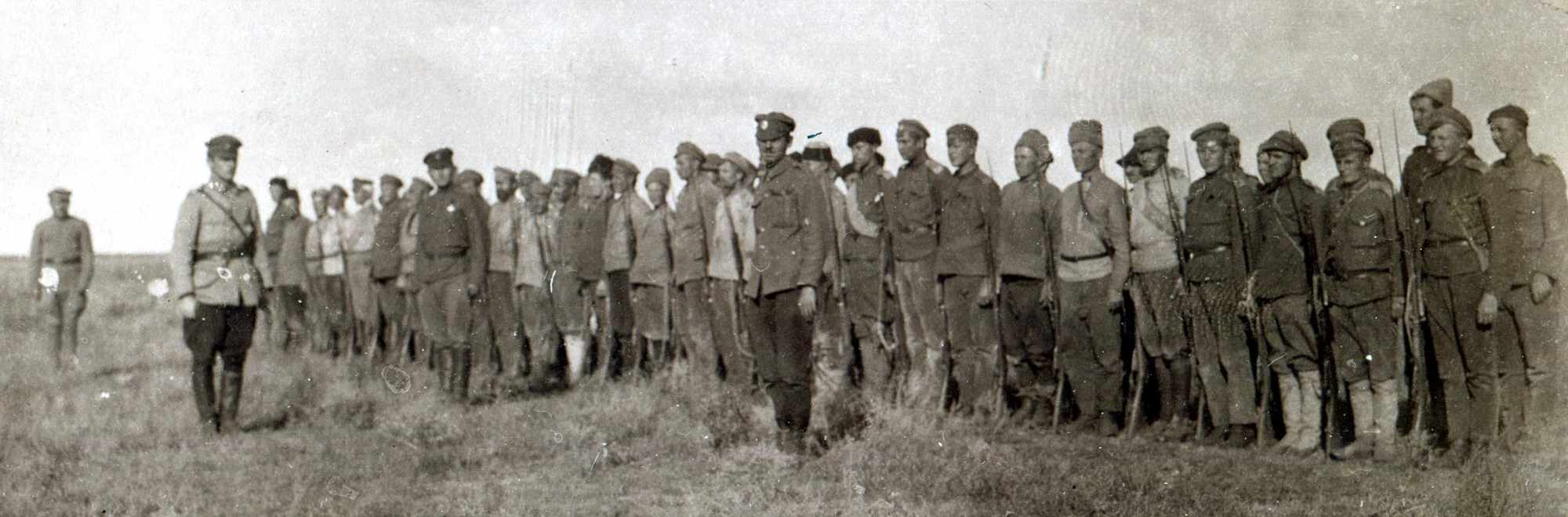
Former Red Army soldiers being trained in the Crimea, 1920
As these photos show, the higher staff did actually have quite a few men in the coloured caps and most seem to have the full shoulder-boards, with piping and cipher. But the rank and file tended to be in whatever came to hand.
Flags
On their way through Ukraine to reach the Volunteer Army, Colonel Drozdovskiy's contingent merged with men from the 1st Marine Regiment of the Baltic fleet. The marines were flying their newly acquired Imperial naval flag of a blue St. Andrew's cross on white. That became the banner of the combined contingent, which was to become the Drozdovskiy Rifle Regiment.
Despite many pictures showing otherwise, it was square with broad blue stripes – not rectangular with thin stripes.

The flag for the 2nd Drozdovskiy Rifle Regiment would appear to be the one below (it is shown on the side of the train above for the 2nd Regiment).

I do not know the flag for the division.
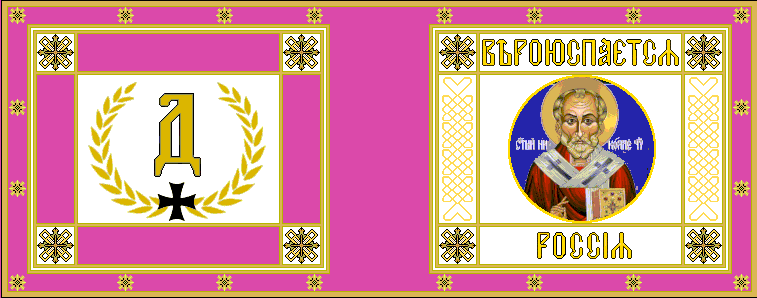
Much later, Baron Wrangel presented the reformed Drozdovskiy Division with a "Nikolai" style flag in the middle of 1920. This was a ceremonial banner, not a battlefield one though. Other than parades, it would have spent its life inside a waterproof wrapper.
Brief History
Colonel Drozdovskiy marched a group of about 1,000 volunteers (two-thirds young officers) from Iasi in Romania to the Don, some 1,200 kilometres. Along the way they picked up other small groups and plundered warehouses, so they arrived larger and better kitted out than when they had started. Then, when they reached the Don, even more volunteers flooded in. Soon the contingent numbered three thousand.
Their merger with the Volunteer Army was to prove tricky. As they had as almost as many men – and were far better equipped – it was not clear which group should merge into which. Drozdovskiy was adamant, however, that he would join with the senior generals of the VA, which solved that problem. The detachment became the 3rd Infantry Brigade, with the original composite rifle regiment becoming the 2nd Officer Rifle Regiment . The Detachment's cavalry divizion was renamed the 2nd Officer Cavalry Regiment. There was also the 3rd Engineer Company, a light artillery battery and howitzer divizion of ten light and two heavy guns. These units all served in the 3rd Division, under the command of Colonel Drozdovskiy (promoted to general in June 1918).
Two lingering issues were to mar the full acceptance of the Drozdovtsy with the senior VA officers. First, the new units were almost entirely monarchists, often quite fierce ones, which jarred with the politics of Alekseev, Denikin and, in particular, General Romanovskiy (VA Chief of Staff). Then, despite the mammoth march across Ukraine, they had not fought in the 1st Kuban Campaign – and the VA would end up being run almost exclusively by old "Ice March" veterans.
However the military success of the Drozdovtsy in the 2nd Kuban Campaign would help it integrate, and it became one of the "shock" elements of the VA. After Drozdovskiy's death in January 1919, the regiment would be renamed the 1st General Drozdovskiy Rifle Regiment in his honour.
On 27 July 1919 the 4th Officer Regiment was formed around officers from the Drozdovskiy Regiment. On 22 August 1919 that unit was renamed the 2nd Officer General Drozdovskiy Rifle Regiment. On 21 September 1919 it was followed by the 3rd Officer General Drozdovskiy Rifle Regiment, again formed around officers of the 1st Regiment. Both units were part of the 3rd Infantry Division.
On 5 October 1919, two weeks before the division was reorganised and renamed the Drozdovskiy Division, the 1st Regiment had 1,352 men and 45 MGs, the 2nd Regiment had 1,309 men and 55 MGs, and the 3rd Regiment had 1,130 men and 12 MGs. The division also had a reserve battalion, Drozdovskiy Engineer Company and Drozdovskiy Artillery Brigade. It also had 500 sabres in a Independent General Drozdovskiy Cavalry Divizion.
As with all the AFSR, numbers fell considerably during the retreat to the Crimea and then rose after, although the Drozdovtsy were far less affected than many others because it had been further east than the other coloured regiments and therefore were pursued less vigorously by Budenny's cavalry.
In April 1920 the regiments and division lost the "Officer" from their titles.
At the beginning of August 1920, the 1st Regiment numbered over 1,000 men, the 2nd only 300, the 3rd 1,000 men and the reserve regiment about 600 men. On 4 September the reserve regiment was converted into the 4th General Drozdovskiy Rifle Regiment (which was a fully soldier unit, with officers only in command positions). By 21 September the regiments numbered 1,500, about 900, over 700 and about 600 men respectively, for a total in the division of 3,260 bayonets and sabres. It still had the engineer company, artillery brigade and cavalry divizion.