
Drozdovtsy Cavalry
Most of the uniform information comes from "The RCW 1917-1922: White Armies", by A. Deryabin, (AST), which is a Russian equivalent of the Osprey Men-At-Arms series.
There were three very different Drozdovskiy cavalry units.
Independent General Drozdovskiy Cavalry Divizion
Initially in the 2nd Kuban Campaign the 3rd Infantry Division had the cavalry that arrived with it from Romania. However that unit was later split off as the 2nd Officer Drozdovskiy Horse Regiment and sent to a cavalry unit.
To provide the now missing integral cavalry support for the infantry, the Independent General Drozdovskiy Cavalry Divizion was formed. It remained as part of the Drozdovskiy Division until the end, growing to 600 sabres at the peak in late 1919.
Presumably it wore the same basic uniform as the infantry. Sergei Mamontov records running into mounted Drozdovskiy scouts who had raspberry caps with white bands.
1st Officer Drozdovskiy Horse Regiment
I know very little about this unit, since Volkov doesn't even list it in his "White Units" book. Presumably it existed, or the more famous regiment would not have been the 2nd of that name.
Apparently it had a white cap, piped red, with a red band (presumably piped white). Shoulder-boards were red, piped white. Trousers were blue with a white stripe.
2nd Officer Drozdovskiy Horse Regiment
This unit originally arrived with Colonel Drozdovskiy, but was to operate quite independently of the infantry unit from 1919. Presumably it was dressed in 1918 as standard Russian cavalry and officers retained their original insignia from whatever unit they had been in while in Romania.
 |
 |
 |
 |
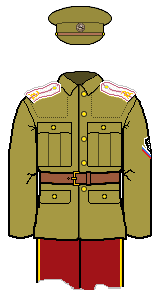
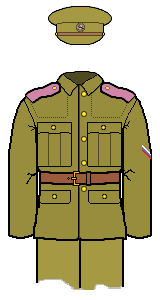
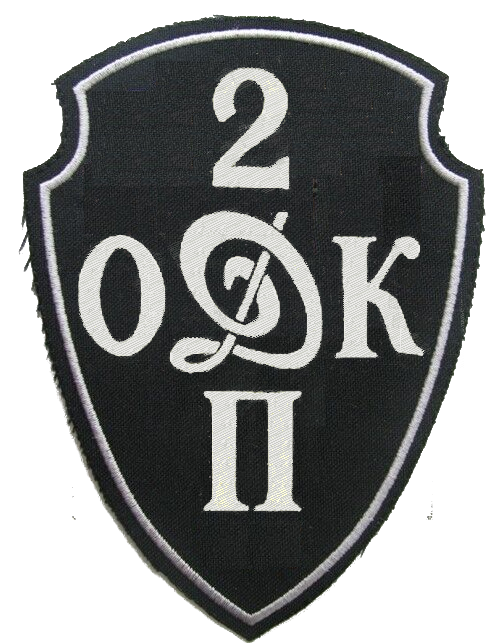
| Officer: 2nd General Drozdovskiy Horse Regiment, 1919 | Private: 2nd General Drozdovskiy Horse Regiment, 1919 | Sleeve badge: 2nd General Drozdovskiy Horse Regiment | Replica pogoni for a tachanka officer |
In 1919 it was largely dressed in British uniforms.
The shoulder-boards were raspberry with white piping and silver lace, with a gold letter "D" for officers, while the lower ranks had raspberry with black piping and a copper letter "D". However, many officers wore their old shoulder-boards and its doubtful the rankers had the metal letters. The "D" was not the Imperial version, but an older ornate version, the same as the infantry (many sites show it open at the top which would have been impractical to cast).
Many officers had been hussars, and wore the red trousers of those units, with yellow stripes.
Greatcoat tabs were raspberry, piped in white.
Because the British uniforms did away with much of the Russian distinctions, such as cap-bands, the unit had an arm badge with the initials of the unit, although not all the men wore it.
Flags
I don't know the flag for the 2nd Regiment, but it may well have been based on the arm sleeve. Certainly unit ciphers in diamonds were very common for RCW cavalry and I have seen a black diamond on white flag drawn for this unit.

Brief History
2nd Officer Drozdovskiy Horse Regiment
Initially created from volunteer officers on the Romanian front by Captain Gaevsky on 5 March 1918 as a Cavalry Divizion (two squadrons) as part of Colonel Drozdovskiy's 1st Independent Russian Volunteer Brigade. It marched from Iasi to the Don.
On 29 April 1918, it was reorganised into a cavalry regiment (four squadrons, a cavalry machine gun and horse sapper komands), mainly from officers and students. From 31 May it became the 2nd Cavalry Regiment. From June 1918 it was part of the 3rd Infantry Division and took part in the 2nd Kuban Campaign, being known as the "Drozdovskiy Horse". In mid-June 1918, it had 650 men in six squadrons. By 7 August it had seven squadrons, and by the end of August nine squadrons.
Towards the end of 1918 the regiment moved north and fought the Makhnovists. Afterwards the regiment retreated into the Crimea and fought in the Kerch area. By January 1919 it was down to only 78 sabres remaining.
From 22 May 1919 it was part of the Independent Cavalry Brigade, then from 19 June to autumn 1919 the 2nd Cavalry Division. In July 1919 it had six squadrons. It was only in October 1919 that it earned the title "2nd Drozdovskiy Horse Regiment".
Operating in western Ukraine, it was cut off by the Red Army's advance in 1920 and participated in the Bredov march as part of the Independent Cavalry Brigade and was interned in Poland.
A divizion of the regiment (three squadrons) was formed in Crimea and placed in the Independent Cavalry Brigade on 16 April 1920 and then two weeks later part of the 5th Cavalry Regiment. The interned members of the regiment arrived from Poland on 25 July with 650 men.