
Alekseevtsy Infantry
The Partisan General Alekseev Regiment was very much the baby of the four coloured regiments, never reaching the size or fame of the other three. There is far less detail about it as a result.
Most of the uniform detail comes from "The RCW 1917-1922: White Armies", by A. Deryabin, (AST), which is a Russian equivalent of the Osprey Men-At-Arms series. However there are very few photos of Alekseevtsy, so confirming what they actually wore is very difficult.
Infantry Uniforms
The original regiment that became the General Alekseev Regiment was a partisan formation mostly made up of very young men – officer cadets and even high school students. The light blue colour chosen represents their youth. It was first associated with them in April 1918, when the women of a Kuban village sewed them shoulder-boards.
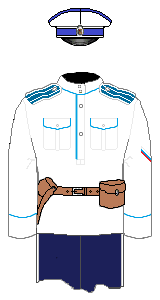 |
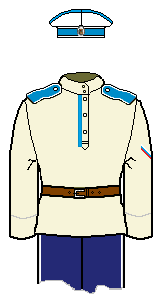 |
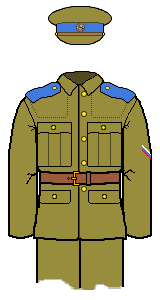 |
|
| Captain: Partisan General Alekseev Regiment, 1920 | Private: Partisan General Alekseev Regiment, 1920 | Captain: Partisan General Alekseev Regiment, 1919 | Private: Partisan General Alekseev Regiment, 1919 |
The "light" blue of the regiment is usually shown as quite a dark shade, rather than a sky blue. The Osprey representation, plate E3, is very much paler than that seen in my Russian sources.
The cap had a white crown, piped light blue, and a light blue hat-band, piped white. Lower ranks were to wear one without a visor (a beskozirka) – such as those of gymnasiums and military academies, which provided so many of the initial members.
The tunic or blouse was ideally white. Regulations were that it was piped on collar, opening, pockets and cuffs. They tried to avoid black tunics (and especially black trousers) but there were some (piped in white).
Trousers were dark blue with a thin white stripe.
We know that in 1919 the regiment wore largely British clothing. It seems unlikely with the massive turnover of the units that low ranks would have had piped shoulder-boards.
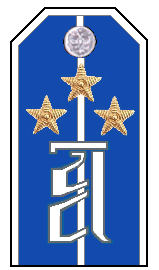 |
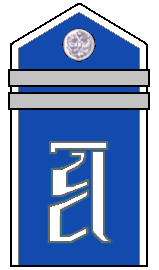 |
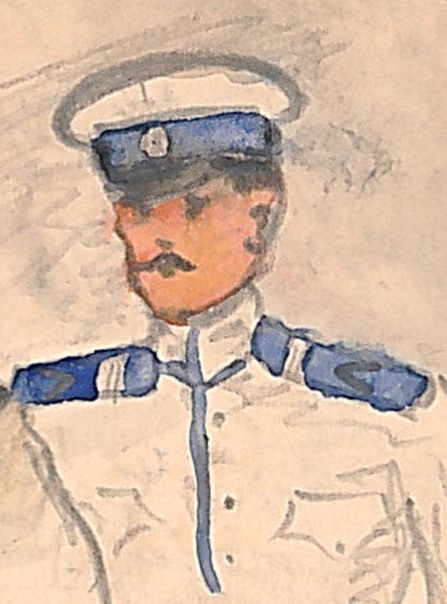 |
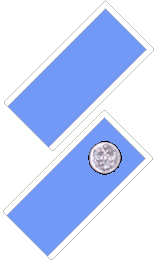 |
| Lieutenant's shoulder-board | Corporal's shoulder-board | A sketch by Sudoplatov of an Alekseevets | Greatcoat collar tabs |
In honour of General Alekseev, in late 1918 the regiment added a stylised white "A" to the shoulder-boards, which were already blue edged white. In practice the "A" was not always added. Initially the officers just used the blue and white, but later some replaced the white with silver. The rank markings are standard Tsarist Russian, and can be seen at the International Encyclopedia of Uniform Insignia site, but just follow the standard system shown here.
How "Coloured" were they?
For once we actually know something about this. In his book on his time with the Alekseevtsy Boris Pavlov wrote in his chapter about the Kuban landings (mid 1920):
During this time we all got better dressed. We sewed ourselves white tunics and uniform caps (blue band and white crown). That summer the tailors and cap makers of Kerch were overwhelmed with work for the Alekseevtsy.
But there was a downside:
Losses were enormous, especially among the officers. Most of them came to the Kuban in the white Alekseev caps of our uniform, visible from far away. It was said that the Reds even had a special command to aim and shoot at "white caps". Almost all the company commanders were taken out.
and when they had returned a few weeks later, after taking massive losses but having taken in an influx of new recruits to replace them:
The regiment was inspected upon arrival back in Kerch. The large number of former Red Army men placed in the regiment completely changed its appearance, making it somehow grey and colourless. There were still a few of our white Alekseev caps in the ranks. However, it could be seen that many of these caps had been left to lie next to their owners in the fields of the Kuban.
That the officers had not already spotted the huge disadvantages of wearing white on the battlefield suggests that not too many had done it before. Still, we know that many of the men wore the full coloured outfits, if only for a short time in 1920. Even then, it would only have been the officers (including those fighting as soldiers), and perhaps a few lower ranks, because the men had to pay for it themselves.
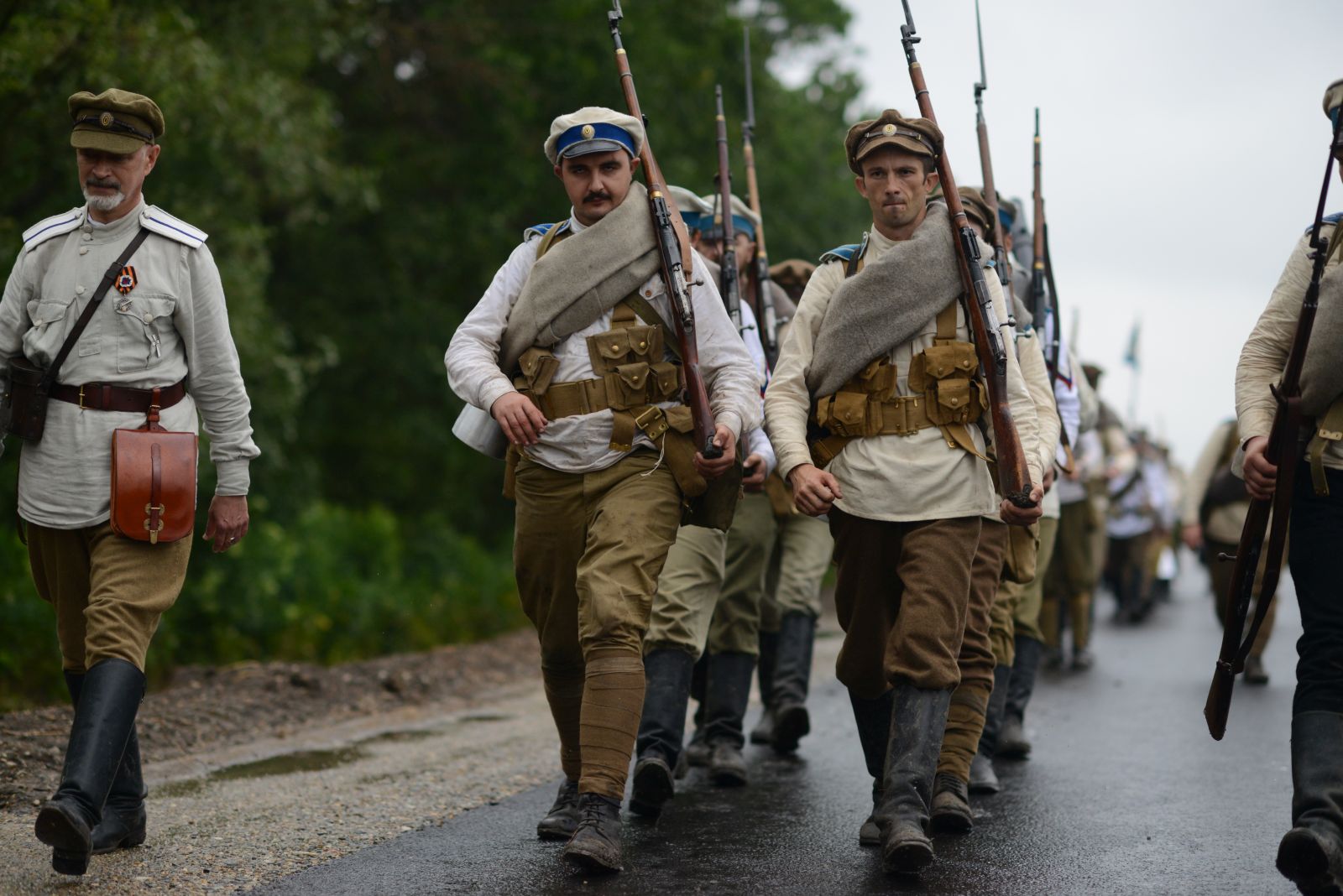
A re-enactment of the Kuban landing, so when the regiment was at its most "coloured".
Note that the really faded blouses give much of the effect of white.
Flags
The flag is from Sudoplatov's memoirs. Presumably the "1" was added only the appearance of the 2nd Regiment and was not required before that.
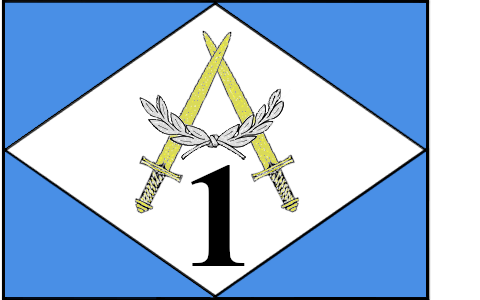
Logically then, the 2nd Regiment would have had a related flag, or there would have been no need to add the "1".

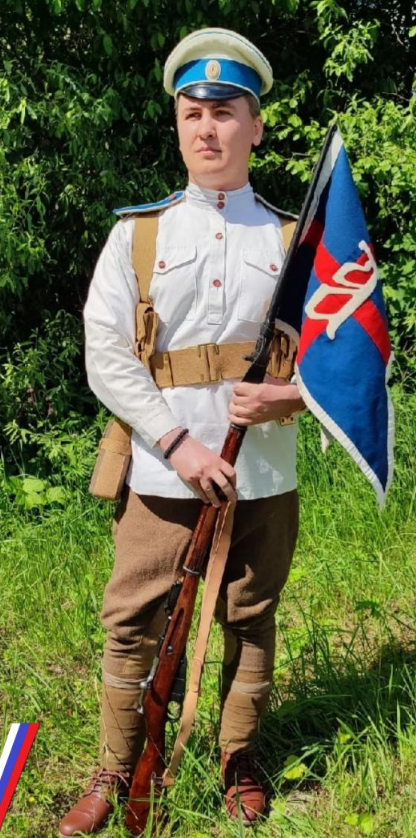
The re-enactor below is carrying what is thought to be the company banner of the 1st Company, 1st Battalion, based a photo from the Crimea. The red cross is based on Imperial regulations, which had a system of horizontal and vertical stripes indicating the number of the company. It is carried on a bayonet cover.
Brief History
The original unit was a partisan foot Cossack regiment, formed in Olginskaya in late February 1918. It took part in the 1st Kuban ("Ice") Campaign and afterwards joined the Volunteer Army with the forces of the Kuban Rada and was placed in the 2nd Independent Infantry Brigade. After Ekaterinodar it returned to the Don and was reorganised before the 2nd Kuban Campaign at the end of May, with the addition of a lot of very young men. In June the regiment was placed in the 2nd Infantry Division.
At the start of the 2nd Kuban Campaign it had 600 men (two battalions, six companies). Taking heavy losses, in November it was sent to Novorossiysk to reorganise. Following the death of General Alekseev it was renamed the General Alekseev Partisan Infantry Regiment.
In January 1919 the regiment was transferred to the Donbas as part of the 1st Division, where it fought until April, and then participated in the Volunteer Army's drive north. On 5 October 1919 it had 1,118 bayonets and 28 MGs. On 23 October 1919 an order was issued for the expansion of the regiment into the 1st and 2nd General Alekseev Partisan Infantry Regiments, and then shortly afterwards an order came to form the Partisan General Alekseev Infantry Division with an HQ, 1st and 2nd Regiments, Alekseev Artillery Brigade, Engineer Company and a reserve battalion. The Samurskiy Infantry Regiment was also attached, along with a divizion from the 5th Cavalry Corps. A third Alekseev regiment was projected, but never came to fruition.
However while officially declared, the division did not form as such due to the defeat of Volunteers at Orel and the following general retreat. On the way to Novorossiysk, in March 1920 the remains of Composite Grenadier Division was joined with Alekseevtsy as a new battalion. After the evacuation to the Crimea, on 7 April the former division was re-formed as the Partisan General Alekseev Infantry Brigade.
After the unsuccessful landing in April 1920 near Genichesk, on 18 May 1920 the Brigade was broken up. The remaining Alekseevtsy formed the 2nd Alekseev Battalion and combined with the 52nd Vilna (Vilnius) Infantry to make the General Alekseev Vilna Regiment. They were sent to guard the Azov Sea coast.
On 27 June an order came to take out the former Alekseevtsy and re-form the 1st Partisan General Alekseev Infantry Regiment. As part of the Composite Division it landed in the Kuban and was in the thick of the action, suffering heavy losses, including the loss of virtually all the grenadier battalion.
From 4 September 1920 it was part of the 1st Brigade of the 7th Infantry Division.