
Useful Terms
One problem with studying this period is the difficulty in understanding terms. Especially if they have changed meaning somewhat over time.
The definitions are only intended to apply for the period 1917-1923.
AFSR : Armed Forces of South Russia – the covering name for the forces commanded by General Denikin and then Baron Wrangel from January 1919 until May 1920. It included the Volunteer Army and the various Cossack Host armies. It became the Russian Army.
Antanta : the transliterated version of the Russian for the Entente, meaning the Allied Powers of WWI.
Assault : a common translation for the Russian udarniy. See shock, which is the usual translation.
Ataman : 1) the leader of a Cossack host (sometimes split between military and civilian roles).
2) any military leader, especially in the Ukraine. Most of the leaders of Green/Nationalist units were titled "Atamans".
Atamanshchina : the tendency of commanders to regard the troops they commanded as "theirs". It was associated with refusal to follow standard military protocol, such as not allowing the high command to appoint commanders, operating independently, not sharing supplies and sometimes a tendency to retain ties to a particular place. The Soviets, particularly Trotskiy, mostly succeeded in stamping it out in 1919, but it remained a problem for both Reds and Whites to the end. The name comes from the typical behaviour of the early war "atamans", who raised personal armies.
Bandit : 1) a bandit.
2) in Bolshevik terminology, any person opposing Soviet power by force, especially those not belonging to the main White or Nationalist factions. Also called a gangster.
Bashlyk : a large hood for bad weather, often coloured when worn by Cossacks or Mountaineers.
Beshmet : shirt worn under a cherkeska by the the Caucasian mountaineers and some Cossacks.
Beskozirka : a cap like a furazhka, but with no visor ("peakless" in American terminology). Associated with students, sailors, the "coloured" regiments of the southern White armies and some other regiments (such as the Guard cavalry).
Black : the colour associated with Anarchism. Anarchists are often called "Blacks".
Black Hundreds : groups of ultra-reactionary Monarchists from before WWI, usually violently anti-Semitic. Sometimes used as a slur for any White group during the Civil War.
Blocking Unit : a unit placed behind the front line to turn back anyone retiring without permission. They were not common in the RCW, but did appear from time to time with the Reds, especially at times of greatest crisis.
Blouse : the term I use for gimnastërka and rubashka. Based on the traditional Russian peasant smock, it has a chest opening that only reaches about a third of the way down and has a low stand-up collar.
Budenovka : another term for shlem.
Burka : large fur cape for cold weather, associated with the Cossacks and Natives of the Caucasus mountains.
Cadet : 1) a young man at officer training school. Soviet officer trainees were called kursanty.
2) a supporter of the Constitutional Democrat party.
3) a counter-revolutionary (the Constitutional Democrats being numerous in the White armies).
Chain : a dispersed rifle line, the standard formation for infantry in combat.
ChEKa : the Soviet internal security force which combined military-, security- and political- police functions. The initials come from the "Extra-Ordinary Commission" portion of the full title: the All Russia Extra-Ordinary Commission for Combating Counter-Revolution and Sabotage.
Cherkeska : the traditional outer garment of the Caucasian "mountaineer" tribesmen, worn by Kuban and Terek Cossacks.
ChON : élite Red Army military units raised from workers or firm Communists (from the Russian initials of Chasti Osobogo Naznacheniya, or Special Purpose Units).
Circle : the literal translation of "krug", the governing body of the Cossack hosts.
Cockade : the badge on the front of a military hat, generally very prominent in White armies.
Coloured (sometimes colourful) : term applying to the Volunteer Army units that wore uniform items of a colourful nature, mostly meaning the Kornilov, Alekseev, Markov and Drozdovski, but also sometimes the Samursky and HQ units.
Combined or Composite : the usual translations of svodniĭ and used interchangeably. This term was often used by White armies to describe units which were formed around the core of a previous much larger unit, usually from the former Imperial Army: thus, the "Composite Regiment of the 19th Infantry Division" was a regiment formed around men who had formerly served in the Tsarist 19th ID.
Commissar : a politically reliable man placed alongside the military commander of a senior Red Army military unit (in theory, regiment upwards) in the RevKom to guard against counter-revolution. The term is often used for any political officer, most of whom should properbly be called Politruks. The RCW commissars were not as powerful as the later Stalinist ones, as they only had powers of veto, not of command.
Communist : More of less invariably used for Bolshevik. Other Marxists were known by their party name, e.g. Mensheviks.
Corps : The grouping of several divisions or brigades in Kolchak's Russian Army. Such Corps were quite small and were grouped into Armies.
Cossack : 1) in Tsarist Russia a hereditary status, with rights and responsibilities tied to service in Cossack units.
2) After the revolution the Ukrainians used it as a term for free soldier (its original meaning) and this carried over to other armies, including the Red Army. Not all later Ukrainian or Soviet "Cossack" units were therefore formed of Cossacks in the pre-1917 sense.
Czapka : the Polish for cap, of any variety (but see Rogatywka).
Directory : 1) when used of a Ukrainian government, another word for the UNR.
2) when used in Siberia, the Ufa Directory.
Division : 1) the smallest unit in an army which mixes arms. Thus very small units might be called "divisions" during the Pygmy Wars as there was no other word to describe units which combined infantry, cavalry and artillery.
2) a very common mistranslation of divizion.
3) a misunderstanding of the name of a unit that is actually a smaller unit formed around a cadre from a previous Imperial division. See composite.
Divizion : a Russian term for a unit between company and regiment size. For artillery and armour the word "battalion" is appropriate, but English does not have a standard translation for cavalry: "demi-regiment" is one option. Note: it is often translated as "division", which is quite wrong.
Dvukolka (plural dvukolki): a two wheeled cart, often used to transport MGs and ammunition. Though the word includes civilian models, the armies much preferred the much sturdier military versions.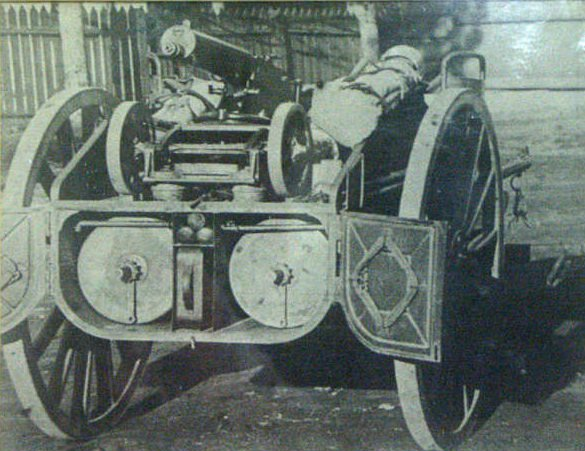
Entente : the alliance that included France, Britain and Russia at the start of WWI was the Entente Cordiale. This came to be the termed used by Russians where "Allies" is more commonly used in English. It became Soviet dogma that all anti-Soviet forces were acting in collusion with the Entente at all times. Thus the 1920 Polish war was sometimes referred to as the "Third Entente Campaign".
Esau : Captain in the Cossack system of ranks.
Forces Group : an ad hoc collection of units for a particular task placed under the leadership of one man.
French: a style of tunic, with two large breast and two large hip pockets.
Front : in the Red Army what is usually know as an Corps in other armies. Thus several Fronts might be at a front.
Furazhka : the standard Russian service cap.
Galicia : the eastern portion of the Ukraine that had been Austrian in 1914.
Gangster : in Bolshevik terminology, any person opposing Soviet power by force, especially those not belonging to the main White or Nationalist factions. Also termed Bandit (2).
Green : the colour associated with those who took a locally-minded position in the struggle between Red and White (although their political position might align either way).
There are also references to Red-Greens and White-Greens as well, indicating local forces who sided more with one Red/White faction than the other, but were mostly interested in local issues.
Gimnastërka (also gymnastiorka, gymnasterka) : the standard military Russian blouse, with or without a couple of pockets on the breast and with no fold-down on the collar.
Greatcoat: the term I use for all heavy weather coats, especially the Russian kittel, but also all the varieties used during the war from the Allied powers.
Horse : a term often used for units which mixed cavalry with infantry, but sometimes just an alternative for cavalry.
Host : the usual translation of Voisko, applying to both the Cossack states and their armies.
Independent : a translation of the Russian otdel'niy in unit titles. Often seen as Separate instead.
International : the international Communist organisation founded in March 1919, also known as the Comintern (for Communitst International) or the Third International, dedicated to world-wide Marxist revolution.
Internationalist : a term for a person from outside the borders of the Russian Empire serving in the Red Army. There were quite a few units of "Internationalists", especially early in the Civil War.
Inorodtsy : various peoples who had different rights from other Russians. Largely traditional societies in the central Asia and eastern Russia, they included various Kirghiz, Kazakhs, Dzungars, etc. Sometimes translated as "alien", but these peoples were legally Russians, albeit administered separately.
Inogorodnie : Russian non-Cossacks living in Cossack lands. They tended to be politically opposed to the Cossacks.
Interventionist : the standard Soviet term for the forces from non-Russian powers which intervened in the Russian Civil War. Includes both the Entente and Central Powers (Germany, Austro-Hungary and Turkey).
IRA : Imperial Russian Army.
Kadet : see Cadet (2) and (3).
Kaftan : a coat, but often used for cherkeska.
Kirghiz : also included Kazakhs in this era, partly because the word for Cossack (Казак, Kazak) is so similar to Kazakh (Казах).
Kittel : an officer's tunic.
KomXxx : the Red Army dispensed with officer ranks and commanders were known by a shorthand for their command: thus a KomDiv (or NachDiv) commanded a division, a KomBrig a brigade, a KomPolka a regiment, KomRoty a company.
Komand : A unit generally attached directly to an HQ between platoon and company (though often quite large). In particular scouts and machine-guns were often organised into komands. Usually translated as "team" or "detachment".
KOMUCH : the abbreviation for The Committee of Members of the Constituent Assembly: a Socialist but anti-Bolshevik government based in Samara. The Czech Legion supplied their main fighting force.
Krug : literally "circle", the governing body of the Cossack hosts, headed by the Ataman.
Kubanka : a low fur hat, frequently worn by Cossacks, mostly in the Western Hosts.
Kursant : a Red officer cadet. Sometimes whole units were formed from such men: they were among the best in the Red Army. The plural is kursanty.
Lace : coloured strips down the opening, the cuffs and along the pockets, associated with the Imperial Guards and Volunteer Army coloured units.
Lava : a historically Cossack cavalry formation, but used by most cavalry in the RCW. It was a loose formation, with the flanks extended forward as a crescent. Generally it sought to seek flanks and weak points rather than charge frontally.
Military specialist : the usual translation for voenspets, which was used for men who had previously been officers in the Tsarist army.
Mountaineer : a person from the Caucasus mountains not of ethnic Russian origin (e.g. Chechen, Dagestani, Ossetian). Most were Muslim, and not particularly well integrated into Russian life. Their traditional dress, with cherkessa was the basis for the dress of the Kuban and Terek Cossacks.
Mortar : the Russian word mortira is often translated as "mortar", but for the WWI / RCW period it would usually be referring to a howitzer with a high elevation. The other word for howitzer was gaubitsa. (Trench mortars were rare in the pygmy wars.)
NachDiv : the correct title of a KomDiv for most of the Civil War.
Nationalist : the term describing factions fighting for an independent country from Russia, whether Socialist or not (e.g. Poles, Romanians, Estonians).
NDA : the Russian Peoples' Volunteer Army, which formed in Poland in late 1920, under the control of Boris Savinkov and then invaded Russia.
Northern Corps : strictly the Independent Corps of the Northern Army. The White army based in Estonia and the immediately bordering parts of Russia that became the North-Western Army. Easily confused with the Northern Army based in the Murmansk-Archangel area.
North-Western Army : the force Iudenich led in his drive on Petrograd.
Officer : when used with respect to a unit, such as the Simferopol Officer Regiment, it implies that there were numerous men serving in the ranks who had previously held officer rank in the Imperial army. Often the best forces in any White army.
Papakha : a fur hat. The standard version is just a simple fur cylinder, with a low fabric crown, often piped in miltary units. The Russian army had issued millions of their own version, which had sides that folded down over the ears. Some other versions seen, especially units wanting to be "Ukrainian", had a long bag which fell down to the side.
Old Style : immediately on the revolution the Soviets adopted the Gregorian calendar but the Whites retained the old Julian calendar, so their dates appear to be 13 days behind. The Russian Orthodox church still retains the Julian calendar even now.
Partisan : 1) a man or unit operating in a non-regular manner, including those operating in the front line rather than behind them. Units tended to keep the title "partisan" long after it was still strictly speaking applicable.
2) Sometimes, in Soviet texts, a proponent of Partizanshchina.
Partizanshchina : the early revolutionary preference for elective and personal of command of units, a liking of irregular warfare, a dislike of operating in a formal command system and an intense suspicion of anything or anyone of the Tsarist regime, and particular voenspetsy/military specialists.
Peoples' Army : the KOMUCH armed forces.
Plastoon, plastun etc : a Cossack infantryman. It originally had the implication of being a scout, but not by 1918.
Pogoni : shoulderboards or epaulettes. Originally large and stiff, with a field khaki side and a dress coloured side. During WWI and into the RCW they often appeared as sewn-on strips on the shirt. Never worn by the Reds.
Politruk : a political worker embedded in the Red Army. Some were commissars.
Razgovory : the system of three large tabs across the front of the Red Army regulation gimnastërka and coat (kaftan/shinel).
Red : the colour associated with the revolution and its supporters.
Red Guard : 1) just after the revoltion, a member of a local self-defence organisation, usually quite left-wing in nature. These were disestablished as fighting units in 1918 and folded into the Red Army.
2) Later used to describe anyone fighting for Soviet power.
RevKom : a member of a Revolutionary Military Committee (RMS, or RVS if using the Russian letters), usually two political and one military officer in command of a regiment or higher.
Revolution : generally refers to the Bolshevik take-over ("the October Revolution") not the previous February Revolution. Thus a "counter-revolutionary" was not necessarily pro-Tsarist in Soviet-speak, as KOMUCH was fully in support of the February Revolution that over-threw the Tsar.
RFSFR : the Bolshevik government of Russia, from initials in Russian РФСФР. The USSR (in Russian СССР) was not formed until after the Civil War period.
RKKA : the Red Army (from the Russian, РККА, the Workers' and Peasants' Red Army).
Rifle : 1) the term the Soviets used for all infantry units.
2) a term used for some White units, but in practice indistinguishable from other infantry.
RMS : see RevKom
Rogatywka : a visored, four-pointed cap, worn by many Polish units.
RVS : see RevKom
RVSR : the Revolutionary Military Soviet of the Republic. This was formally the highest command of the Soviet forces, chaired by Trotski and containing the military Commander-in-Chief (Vatsetis, then Kamenev).
Rubashka : an other ranks version of the blouse (officers wore a gimnastërka).
Russian Army : the name given to Kolchak's Army. Then, with its collapse, the name was taken by Baron Wrangel for the White forces under his command in May 1920; the successor to the AFSR.
Separate : a translation of the Russian otdel'niy. Usually better translated as Independent instead.
Sharovari : trousers
Shinel : greatcoat.
Shlem : the Red Army's new regulation pointy hat which entered service in large numbers only towards the end of 1920.
Shock : the usual translation for the Russian udarniy. In WWI used for special volunteer battalions designated at the spearheads of attacks. In the Civil War period quite a few regiments received the term more out of hope than actual performance. Also translated as storm and assault.
Shoulderboards : the usual translation of pogoni, being the unit and rank markings worn by soldiers on their shoulders.
Sotnia (plural sotni): the Cossack term for squadron, literally meaning "hundred". Sometimes also used for plastun companies.
Soviet : 1) the Russian word for committee. Later any organ of Bolshevik power.
2) after 1917, another word for revolutionary.
Sovnarkom : the Council of People's Commissars: the official governing body of Soviet Russia.
SR: Socialist Revolutionary. The party had split by the civil war period into the Left-SRs, who were by far the most popular party with the peasants, and the Right-SRs. Many Left-SRs worked with the Bolsheviks, but others with KOMUCH and similar opponents. Sometimes written in Russian as "Esser".
Stanitsa: literally "station", but also a Cossack village.
Station: both a railway station, and a Cossack village, which can cause confusion when the Cossack village had a separate railway station.
Note that many Russian railway stations were often quite a long way from the villages for which they were named, but also that some stations were named differently from the village that they were in.
Storm : a common translation for the Russian udarniy. See shock, which is the usual translation.
Tachanka (Polish taczenka) : a heavy machine gun mounted on a horse-drawn cart and usually used to support cavalry with firepower. The number of horses could vary from two to six, but three and four seem most common. The wagons were generally civilian models, preferably well-sprung.
Transcaspian : basically the area now known as Turkmenistan.
Transcaucasus : basically what is now Armenia, Georgia and Azerbaijan.
Turkestan : Russian Turkestan was Bukhara and Khiva across to the Semirech'ye area (now Zhetysu in Kazakhstan). Chinese Turkestan is the Sinkiang, now Xinjiang in China. However, for a while the Soviets had a "Turkestan Army" that was nowhere near Turkestan, instead operating in the Orenburg region.
Ufa Directory : technically the Provisional All-Russian Government, it was the common name for the merger of the Komuch and the Provisional Siberian Government. Quickly overthrown by Kolchak.
UGA : Ukrainian Galician Army. A Nationalist unit, from the previously Austrian part of the Ukraine, separate from the UNR.
UHA : another term for Ukrainian Galician Army (Galicia starts with H in Ukrainian).
UNR : the Socialist but non-Bolshevik government of the eastern portion of the Ukraine, formerly Russian, under Petliura.
VA : Volunteer Army.
Vsevobuch : a training system set up to train workers, and particularly factory workers, in the use of weapons and tactics. Some units were sent to the front from this system. They tended to not be very good, as they lacked experienced commanders and equipment.
Volunteer Army : generally the main non-Cossack counter-revolutionary army of south Russia, led by Generals Kornilov, Alekseev and Denikin. This merged into the AFSR. There were other White groups that termed themselves the "Volunteer Army" but they generally get an additional title (Peoples' VA, Astrakhan VA etc).
VChK, VChEKa : see ChEKa.
Voisko : see Host.
VOKhR : a Soviet internal security organisation combining various units tasked wtih guarding roads, rail lines etc and aiding the Soviet food supply functions. It did field units on the external fronts from time to time.
Volost : a territorial division of Tsarist times, containing a few villages, which then elected a council with some basic administrative and judicial functions. The nearest English equivalent is parish.
VnuS : a Soviet internal security organisation formed for all internal security functions, including the ChEKa. In March 1921 its forces were transferred to the Red Army.
White : 1) the colour associated with those supporting the counter-revolution.
2) in Bolshevik terminology, anyone who opposed Bolshevik power (including some who supported the revolution and opposed the counter-revolution).
White Guard : a Bolshevik term for a soldier fighting for the Whites, or just any counter-revolutionary.