
Which Front?
The first question many people new to the Russian Civil War ask is: "which front should I game?" Obviously the answer depends on personal preference, but I shall list some pros and cons for each.
I have attempted to list all theatres that are potentially gameable at above skirmish level. There are an astonishing amount.
The country lines on the sketch maps shown how the world stood at the end of 1922. While I sometimes distinguish the various Soviet Republics which were formally fighting each war they were all directly controlled by Moscow anyway (the USSR was formed in 1921).
References to the amount of information is in regards to the amount in English only.
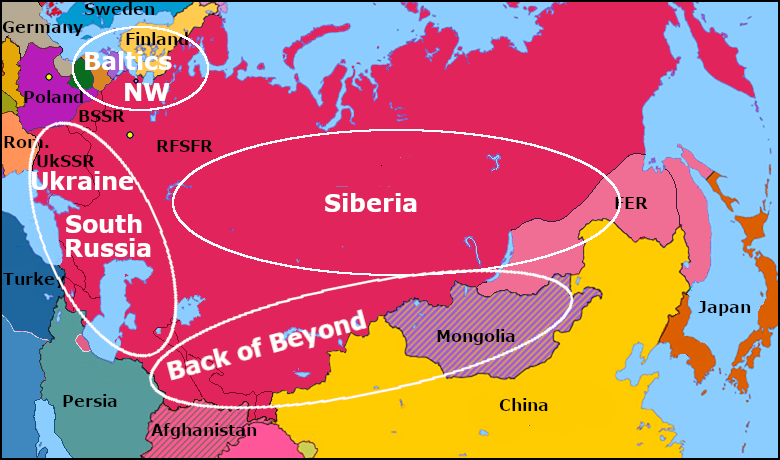
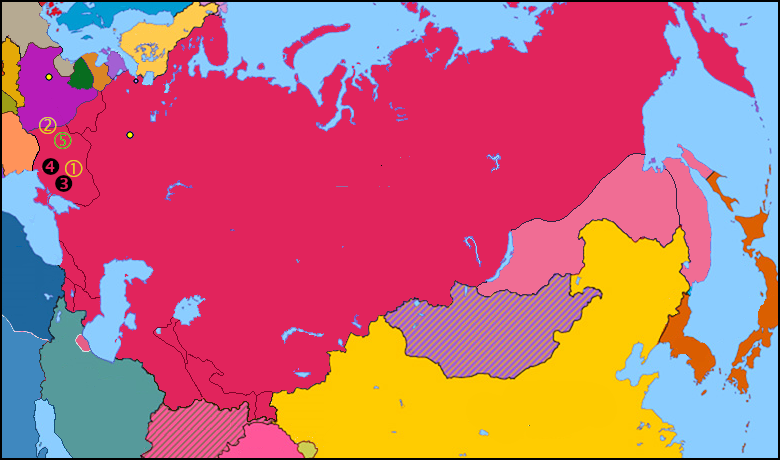
South Russia / Ukraine
Main White Southern fronts
Most wargamers game the south of Russia from mid-1919 through to the end of 1920 and the evacuation from the Crimea. It has the most famous units, the most colourful uniforms, the most variety of troop types, most of the famous generals and the most armour.
Size: many large battles
Uniforms: lots of variety and colour
Cavalry: lots
Troop types: White regulars and Cossacks; the entire variety of Reds
Armour: trains, cars, planes, tanks (Whites)
Information: plentiful
My conclusion: unless you have a reason to do otherwise the campaigns of the Armed Forces of South Russia against the Soviets should be your starting point when gaming the RCW.
All the required figures are easily available in 15 mm. I would suggest that scale, or smaller, so the battles can be ones of manouevre.
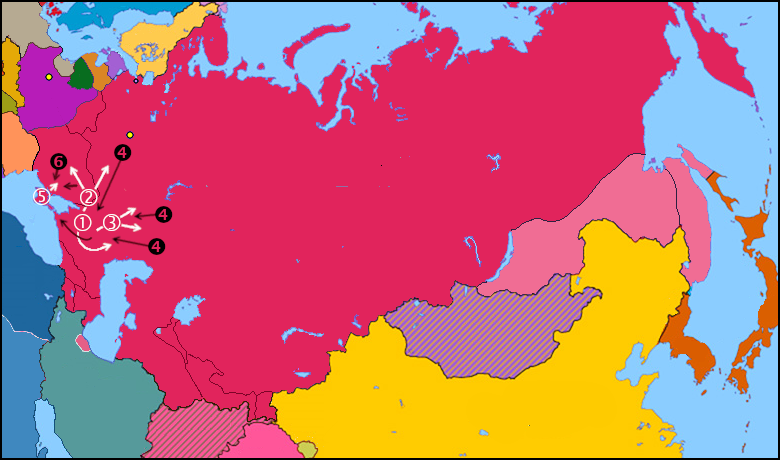
The first serious White fighting in the south was the fledgling White units in its 1st Kuban Campaign. Badly outnumbered, they were forced to retreat.
(1) Then in mid 1918, the new Volunteer Army cleared the Kuban in the Second Kuban campaign. This period is characterised by very good but tiny White units fighting many times more numerous but disorganised and unco-ordinated Red units.
(2) Following the German's departure in late 1918, the Don Cossacks occupied the Donbas with little opposition. The Reds then attempted to take it back. The Cossacks were unable to hold and were replaced by the Volunteer army. Heavy fighting took place, but with little movement (unusually for the RCW). Eventually the Whites overpowered the Reds, aided by Allied support. With the formation of the AFSR, Denikin launched his Spring 1919 campaign. The main White drive of the Volunteer Army was northwards towards Moscow, although also fighting Makhno and the Ukrainians. By now the Red Army was organised and a lot more professional, whereas the Whites were less elite than previously.
(3) Meanwhile the Caucasian Army, largely Cossacks but with regular support, including artillery and tanks, took Tsaritsyn and drove north from there.
(4) The Red counter-offensive drove them back, first into the Kuban, and then in early 1920 forced the few remaining on to the Crimea. Budenny's Horse Army gained its first great victories during this time.
(5) Taking over from Denikin in the Crimea, Wrangel renamed his army the "Russian Army" and launched a major attack north while the Soviets were occupied fighting the Poles.
(6) Eventually the Reds regrouped and the Whites were evacuated. Most of the fighting in this campaign was by veterans, on both sides, with huge amounts of cavalry.
Other than the Kuban, the terrain is mostly quite flat or rolling, but with villages and forests to allow for interest, and easy to put on a table top. The Kuban, by contrast is very flat and almost entirely featureless. Attacks were almost always for possession of a village, rail junction or river crossing.
Smaller White Southern fronts
Formally under the control of the White forces in the south (VA, AFSR, RA) were some side theatres that in practice were entirely independent.
Size: moderate
Uniforms: mostly khaki
Cavalry: lots
Troop types: White regulars (Cossacks in Kuban); generally low-quality Reds
Armour: some cars, a few planes
Information: some, but you have to dig
My conclusion: very gameable if you already have the figures for South Russia. The smaller scale and isolated nature of these theatres mean they make for good mini-campaigns, yet with an interesting mix of troops on both sides.
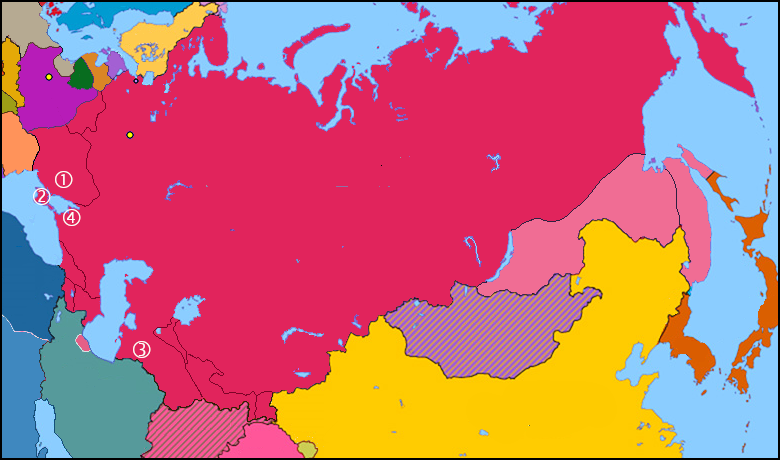
(1) When the Whites were first assembling in Rostov at the start of the war, there were several long marches by large columns to join them – The Drozdovski March and Ekaterinoslav March being the most famous.
(2) The Crimean-Azov Army formed in the Crimea in 1918 at the same time as the Volunteer Army in the Kuban. It fought the Reds there until the 1919 Spring Campaign.
(3) The AFSR included the Turkestan Army, fighting in what is now Turkmenistan. The Whites get to include some poor quality locals, both infantry and cavalry, and for a while British support. The Reds are basically railway worker units, plus auxiliaries. The fighting was entirely along the rail line, with improvised armoured trains.
(4) In an attempt to distract the Soviets, Wrangel launched a raid on the Kuban in mid-1920. There was also a similar attempt to raise the Don Cossacks, but it failed miserably.
Cossack theatres
At the start of the Civil War, the Cossack hosts tried to go separately, but lack of quality infantry and technical weapons meant that their frequent victories in the field were stymied by their inability to take fortified towns. In the end they were merged into the AFSR, quite reluctantly in the case of the larger Don and Kuban Hosts.
Size: moderate
Uniforms: traditional Cossack, motley Reds
Cavalry: lots for Cossacks, some poor quality for the Reds
Troop types: Cossacks and standard Reds
Armour: some trains, some cars, a few planes
Information: depends on the theatre somewhat, but some
My conclusion: if you really want armies only of Cossacks, why not? But generally you can do that in the AFSR era anyway, with much more interesting terrain and more varied support. In the early phases of the war the Red cavalry was generally poor, so if you want good quality on both sides you need later periods.
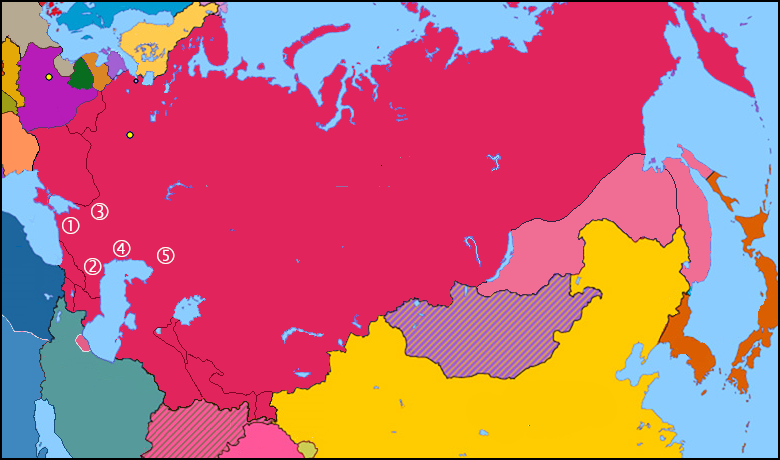
(1) The Kuban Cossacks, before the VA conquered the entire region in their 2nd Kuban Campaign of late 1918, fought a nasty three-sided between themselves, Reds and the independently minded Caucasian mountaineers (Chechens, Ingush, Daghestanis etc) in 1918. Shkuro's "Wolves" were active in this region.
(2) The Terek Cossacks in 1918 followed a similar path to the Kubans, fighting local Reds and mountaineers. (They were to become much more reliable allies of the Whites though than the ever-fractious Kubans.)
(3) The Don host was one of the earliest active fronts of the Civil War, and basically protected the early growth of the VA from the Soviets. They had wild swings of fortune in 1918, several times clearing its area of the Reds, only to fail to take Tsaritsyn – twice – and collapse again. Very much the largest host, it had sizeable numbers of trains, cars and planes, but insufficient quality infantry and artillery (especially officers). Budenny started his career here.
(4) The Astrakhan Host mostly fought separated from the main body of the AFSR, up and down the lower Volga. The forces involved were small, but interestingly varied.
(5) The Urals Host maintained healthy political contact with the VA and AFSR, but other than getting some ammunition from them, it fought entirely separately along the Urals River, mostly for possession of Uralsk. This is the theatre of the famous Chapayev.
One negative is that terrain is usually boring. Much of the fighting took place on largely featureless steppes, most often for possession of a town or river crossing, except for the Kuban and Tereks fighting mountaineers.
The Ukraine
The Ukraine in the Civil War had a bewildering range of factions – seemingly each opposed to all the others – though sometimes allying for short periods. I have only listed the armies here that could field a division of combat ready troops.
Size: mostly small
Uniforms: mostly dull
Cavalry: very little, poor quality
Troop types: poor quality, other than UGA and Makhno
Armour: a few trains and cars
Information: politically enough, militarily not much
My conclusion: Makhno would be an interesting option if your friends have Whites and Reds and you want a third army to fight both of those.
The rest are niche interests, although UGA comes for free if you have WWI Austrians, and Grigoriev similarly if you already have early war Reds.
The first fighting was when the Bolsheviks invaded straight after the October Revolution. A Ukrainian nationalist group in Kiev, the "Rada", was not able to produce substantial resistance.
Then the Central Powers swept the Bolsheviks out with the signing of the Brest-Litovsk Treaty (March 1918). There were sporadic attempts at resistance by local Red groups, with pockets of heavy fighting, and even some local victories to the Reds. However the Central Powers were far too strong. The Germans then threw out the Rada, and imposed Hetman Skoropadski. They both then controlled the towns, but not the countryside, which was rife with partisans. With the end of WWI, Skoropadski's regime collapsed utterly, with almost no fighting (the reliable parts of this army all going to the Whites or the UGA).
The Bolsheviks swept in again, with sporadic Ukrainian resistance. Their army was largely mobilised partisans rather than regulars – the Kolchak front was the priority at the time and got the best forces. Many of the units even retained their original partisan leaders, of very marginal reliability (Makhno, Grigoriev, Zelenyi all fought alongside the Reds before fighting against them). Even the non-partisan commanders often operated largely as warlords, such as Dybenko with his personal fiefdom in the Crimea.
(1) The eastern Ukrainian nationalists headed by Petliura, now called the "Directory", did however retain some territory with their UNR army. Always outnumbered and poorly supplied they were able to deal with the Reds, just, as the Ukrainian Soviet forces were not very effective. Generally separated from the Poles, the UNR were entirely unable to hold against the Whites when Denikin started his push north, but survived in a pocket as they were not a major threat. But when the Reds turned Denikin back in late 1919 and once more invaded the Ukraine, there was nowhere to hide and they were forced to take shelter with the Poles.
(2) The former Austro-Hungarian areas of the Ukraine (Galicia) formed a separate Ukrainian army, the UGA (sometimes UHA), based around men who had served in the Austro-Hungarian army. It was quite a good, with very good artillery, but was outnumbered by the Poles, their primary opponents. They were eventually absorbed into the Red Army when the Ukraine fell to them again.
(3) Makhno started out working alongside the UNR, but allied loosely with the Reds whenever they controlled the area. His focus of attention was always the White armies until after they were defeated in the South. At that point the Reds moved against him, and eventually were able to wipe out his Ukrainian Insurgent Army. From time to time he was able to muster quite sizeable and well organised forces, and was a formidable opponent, willing to take on the enemy in open field battle.
(4) Grigoriev (Hryhoriiv in Ukrainian) was, like Makhno originally associated with the nationalist Ukrainian cause. He allied with the Reds in the second invasion (end of 1918) and was primarily responsible for defeating the French/Greek intervention in Odessa. He then decided to strike out independently, and went on a rampage with quite a large force, largely at the expense of the Red Army. Defeated, he fled to Makhno, who soon had him shot.
(5) There were other "Green" armies, most of which were politically affiliated to the Ukrainian Independence cause, sometimes aligning Red when it seemed suitable, but too anarchic to be controlled by anyone for long. One of the largest of these was that of Zelenyi. However, even those with thousands of armed men mostly avoided set piece battles, and fought by ambush, night attacks etc, taking full advantage of their superior knowledge of the area.
Siberia
White fronts
The other large White front – at its peak the largest – was in the East. One disadvantage is that it divides into quite distinct periods, with very different armies in each.
Size: initially small, then many large battles
Uniforms: mostly khaki
Cavalry: some, lots for Cossacks
Troop types: almost every sort
Armour: trains, cars, boats, some planes
Information: patchy, but OK for Kolchak and good for Semenov
My conclusion: early Siberia has a lot going for it. This is the period when you can put together a complete mish-mash of units on both sides and still be historical: Red Latvians, Red Hungarians, Sailors, Red Guards, White Czechoslovaks, White Officer units, Cossacks and all. You can also attempt to rescue the Tsar or seize his gold.
The Kolchak period had much larger armies, but lacks the same charm. After the Battle of Cheliabinsk (July-August 1919} the whiff of inevitable failure is rather depressing.
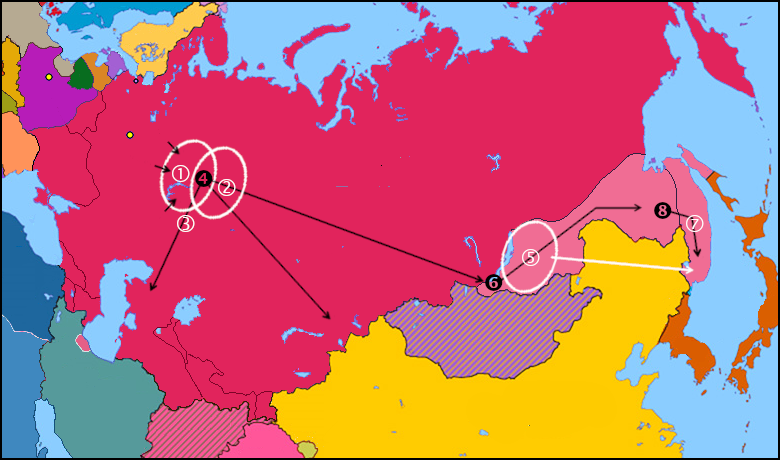
The first fighting was between emergent Red and White factions across the vast expanse of Siberia. Eventually the various groups coalesced, with governments and armies forming.
(1) The first large White (well, anti-Bolshevik, because they were Socialist) government was KOMUCH. Their "People's Army" was tiny and its success was almost entirely down to their Czechoslovak allies. The Reds opposing them were an interesting mix of Red Guards, sailors, internationalists and ex-regulars.
A Siberian Government was also formed, further east, but the Reds in that area were largely partisans and its large "Siberian Army" did very little.
The Reds were able to overwhelm the small People's Army, who were reluctant to conscript. Eventually the brief Ufa Directory attempted to merge the entire Siberian anti-Bolshevik forces as the Reds started to get more professional and well-organised.
(2) In November 1918 Kolchak seized power. This, along with the end of WWI, led to the Czechoslovaks withdrawing their support, and they retired from the front lines to guard the Trans-Siberian Railway. Kolchak's 1919 Spring Offensive was initially successful, and much of western Siberia was seized by his "Russian Army".
(3) The Orenburg Cossack host fought alongside the various other anti-Bolshevik government with a small amount of interchange in units. This is the only main Eastern front that had significant amounts of cavalry.
(4) However the Reds continued to pour men in, prioritising the defeat of Kolchak, and weight of numbers started to tell. After a retreat, there was a final attempt to turn the tide at Cheliabinsk. With that failure Kolchak's army collapsed, and a disastrous winter retreat ensued. The Orenburg host were swamped at the same time and also retreated. Most headed east along the Trans-Siberian, but some went south, towards Semirechensk.
(5) The Red advance was halted for half a year by Ataman Semenov's "Far Eastern Army", made up of his Cossacks and those Whites who had survived the winter "Ice March" with the Reds pursuing. The support of the Japanese was crucial, because the Red Army was reluctant to fight them directly.
(6) In order to stay at arm's length from the Japanese, Lenin set up the "Far Eastern Republic", but it was very much run from Moscow. Its army, the NDA, eventually overwhelmed Semenov, and the remaining Whites fled to China in late 1920.
(7) Some of them made it across to the Priamur Provisional Government, in the Maritime Province. General Diterikhs organised a small White Army there, once again behind the shelter of the Japanese.
(8) When the Japanese withdrew from Russia, the NDA launched a campaign, and in November 1921 the Whites were defeated and retired to China. This is often considered to be the final act of the Russian Civil War, as the USSR was now cleared of all enemy factions who controlled territory. Fighting did, however continue.
The terrain of the areas with substantial fighting is mostly very flat. The north has forests, but middle Siberia gets quite bare as one heads south. Orenburg is largely steppe.
Red Fronts
During the Civil War the Soviets held the central lands and were able to impose a uniformity in terms of organisation and control. However the sheer size of Siberia led there to be several armies that were isolated from the main Red Army.
Size: quite decent
Uniforms: patchy for Reds
Cavalry: some
Troop types: lots of variety
Armour: a few cars, some trains
Information: mostly lacking
My conclusion: a bit niche, but being quite similar to the Red Army of 1918, with partisan and worker units mixed with some regulars and Internationalists, they avoid the blandness of late Red Army.
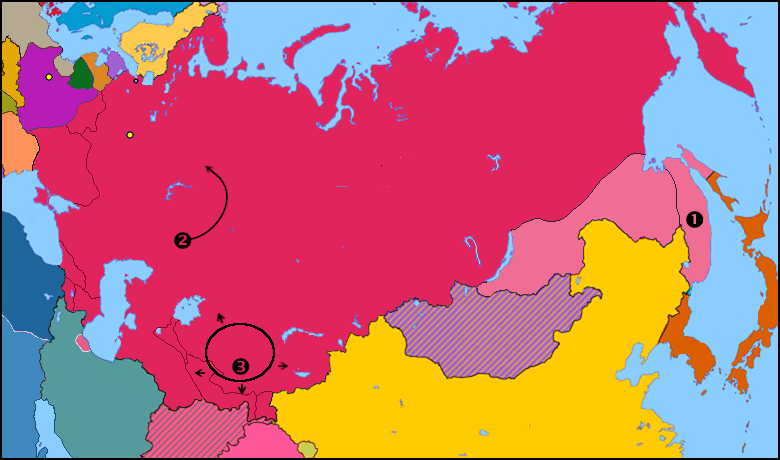
(1) At the start of the fighting a revolutionary army formed in the far East. It faced off against the Intervention forces, and at Kraevski a couple of actions were fought. This is about the only time British and French forces fought in Siberia, and showed that they really were not going to be much help to the Whites. The Japanese, however, drove back the Reds fairly easily. They, and their Cossack ataman clients, established control along the Trans-Siberian east of Lake Baikal and the Reds in the area were forced to go underground in the cities or become partisans.
(2) The Urals March was an episode much celebrated in Soviet history. It occurred because when revolutionary forces started to assemble in early 1918 in the Orenburg, Ufa and Cheliabinsk areas, in opposition to local anti-Bolshevik groups also forming there, they found themselves increasingly isolated and in trouble. In July 1918, a group in the Orenburg area set off to break out of their encirclement. As they moved they gathered up similar units, under the command of Blyukher, and fought off various White units attempting to block their path. By September they finally made it to the main Red lines, now numbering some 10,000 men. The original group covered some 1,500 km.
(3) Another isolated group was the Red Turkestan Army. Centred on Tashkent, they faced the White Turkestan Army to their west; the Orenburg Cossacks to their north; the Semirechensk Army to their west; and Basmachis largely to their south. They were able to hang on, with some difficulty, until the Orenburg Cossacks broke and Frunze's Turkestan Front could make it to them in early 1920.
"Back of Beyond"
These are the theatres of the RCW that seem too surreal to be true. They bring an extra dimension in troop types, uniforms and batshit-crazy warlordism.
Size: quite decent
Uniforms: some crazy stuff on the White side vs normal Red Army
Cavalry: mostly, on both sides
Troop types: lots of variety
Armour: a few cars, some Red planes
Information: variable, depending on the theatre
My conclusion: the theatre for those that want maximum colour and variety in their games.
This is a period for 28mm, to maximise the visual appeal and because that's the scale the figures are available in. There are good rules for the period that border on role-playing as much as strict historical accuracy.
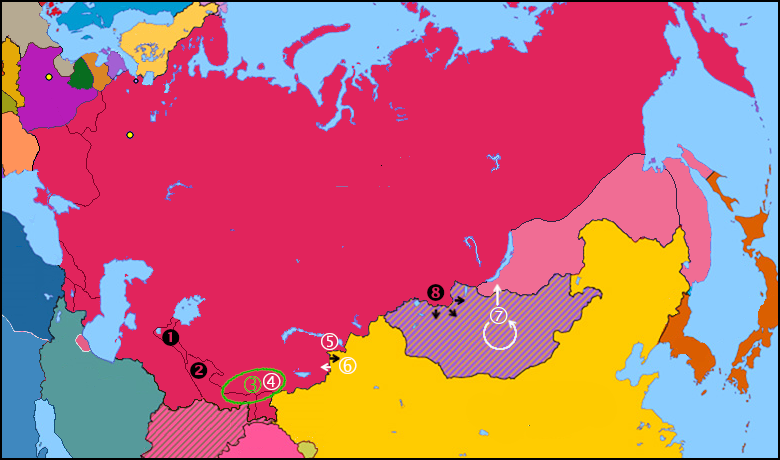
(1) The Red Army suppressed the Khanate of Khiva at the beginning of 1920. The Khan's supporters lasted a couple of months, but were greatly outnumbered. The short-lived Khorezm People's Soviet Republic was merged into the USSR within a few years.
(2) In August 1920 the Emirate of Bukhara suffered the same fate. The Red Army under Frunze was considerably too powerful, and resistance only lasted a few days. The Bukharan People's Soviet Republic was also quickly merged into the USSR.
(3) While Khiva and Bukhara fell quickly, their loss fed into the simmering tensions among the Muslim population of the area. The Basmachi Revolt in the Ferghana Valley grew to be a significant problem for the Tashkent Soviet by 1920. With the arrival of Frunze and the regular Red Army a major campaign to defeat it was undertaken. The Red Army used largely cavalry, backed up with planes. The Reds struggled to pin down their more mobile opponents, and it was 1926 before most of the opposition had been stifled. Sporadic fighting broke out for a decade afterwards.
(4) One interlude in the Basmachi Revolt was the arrival of Enver Pasha from Turkey in late 1921. He persuaded some of the local leaders to co-operate under his control, and a sizeable force was gathered. Unfortunately Enver was not much of a general, and operating as a more regular force played to the Red strengths. After several defeats, Enver was killed in August 1922.
(5) There were several White generals who set themselves up as warlords in eastern Siberia. Most were run-of-the-mill Atamans of no great interest, but one of the more successful and interesting was Ataman Annenkov in the Semirechensk. He established an army that was part colourful regulars and part Cossack, supplemented by local tribes. The Semirechensk was an active but minor theatre in 1919 and into early 1920, but became important when the refugees from Kolchak's army and the Orenburg Cossacks arrived following their retreat. Annenkov held out briefly, but in March 1920 he and his allies were forced to retreat into China.
(6) Those White armies retained their fighting capability in the Xinjiang (Sinkiang, Chinese Turkestan) area. There was a largely Cossack one based around Annenkov, and a largely White Russian commanded by General Bakich. Both they and the Reds crossed the border to attack each other for long afterwards. Eventually a combination of political pressure, incursions and assassinations by the Soviets forced the dispersion of the White armies away from Xinjiang.
(7) Then there is Baron Ungern-Sternbeg – a favourite among gamers. A man of some charisma, but precarious mental stability, he attempted to set up a pan-Russo-Mongol kingdom under his control. While moderately successful in Mongolia, his invasion of the Soviet Union in mid-1921 was quickly suppressed. While not particularly effective in a military sense, his army made up for it by being extremely colourful: a glorious mixture of Mongols, Turks, Russians, Cossacks, Chinese and Japanese.
(8) There were some other White Russian players in Mongolia, such as Kazagrandi, with the same ambitions but without the luck or skill that Ungern-Sternberg had. The Soviets infiltrated from time to time to remove them. Eventually they made that country a client state.
The Baltic
Baltic Nationalists
A bit of a favourite of mine, partly because you can actually visit the battlefields relatively cheaply and easily, unlike most of the RCW. On the down side, trying to follow the wars is made difficult by their confused nature and while there is good information on them, it is generally not in Western European languages.
Size: moderate
Uniforms: khaki
Cavalry: little, and poor quality
Troop types: some variation
Armour: cars, planes, trains
Information: little or hard to get
My conclusion: there's some good gaming options with the Baltic nationalists, but the difficulties of getting information in English can be crippling.
Much of the terrain is quite closed, with forests, marshes and rivers, which means cavalry was scarce and artillery could not dominate. However that makes it quite good for small games, because you don't need the room for wide manouevre that characterises most of the RCW, and for kriegsspiels.
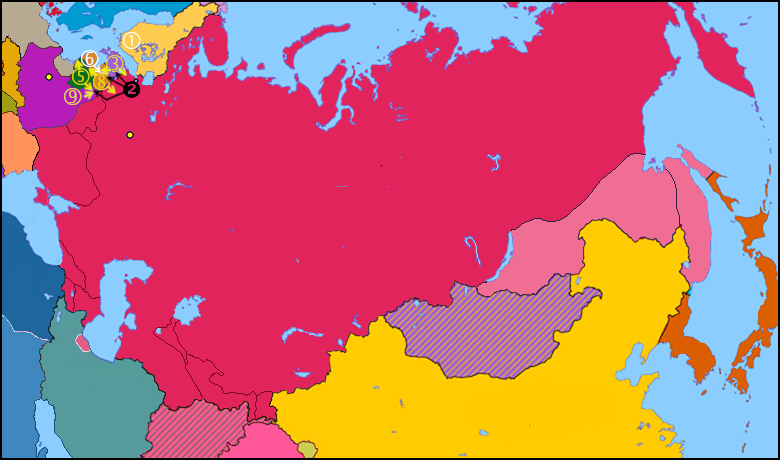
(1) The Finnish fought a short, sharp civil war. It started in early 1918 when the Red Guards, with support from Soviet Russia, attempted to take control of the area. The anti-Bolshevik populace hastily assembled an army, and at Tampere and Vyborg turned the tide. A German contingent arrived later, and helped with mopping up operations, but by then the Whites were already firmly in control. Many of the Reds fled to Russia. By the time WWI ended, Mannerheim had complete control of the country, and it was impractical for the Soviets to attempt to invade, especially with the British navy in the Baltic.
Although fighting more or less stopped on the main front, in Karelia the small Olonets Volunteer Army continued to advance into 1919. With the general improvement of the situation in Soviet Russia more troops could be sent to fight, and slowly the Reds regained southern Karelia.
(2) With the collapse of the Central Powers at the end of 1918, the Soviets rushed to take control of the Baltic states. Unfortunately, from their point of view, they had only very small forces in the area (the so-called "screens" that had been facing the Germans). By the time the they could move in larger forces, organised resistance had appeared.
(3) Estonia very nearly fell to the forces of the Estonian Socialist Republic, but the anti-Bolshevik Estonians quickly built up a small but very effective army, which just managed to hang on around Tallinn. Soon afterwards a short campaign regained most of the Estonian-speaking areas, at which point the Estonians were no longer interested in fighting the Soviets. They did, however, support some White Russians (see next section) who had been gathering behind the German lines in 1918.
(4) Latvia was completely under foreign control by the start of 1919: the vast bulk was under the newly formed Soviet Latvian Republic, but a small area around Leipaja remained under German control. Nationalist Latvian units started to form, some under the protection of the Estonians and some with the newly emerging Freikorps.
(5) In early 1919 Lithuania was quickly divided up between a Lithuanian Soviet Republic, the Poles, the Germans and a very small independent Lithuanian state based around Grodno.
(6) The remaining Germans in western Latvia and northern Lithuania turned into a Freikorps, with the aim of retaining the area under German control. They launched an offensive in early 1919 which gained them most of Kurzeme, and then in mid-199 quickly drove the extremely unpopular Latvian Soviets from most of the rest of the country. They were assisted by a small Latvian unit.
(7) The Estonians, alarmed by the concept of a nascent German power in the area, moved into Latvia and defeated the Freikorps at Cesis, with some Latvian support.
(8) That Estonian defeat of the Freikorps allowed an independent Latvian state to emerge. It organised an army, which drove the Freikorps out in late 1919, and then slowly regained the area around Daugavpils from the Reds, who were preoccupied with more important fronts. Latvia and the Soviets reached an uneasy peace in 1920.
(9) While the new Lithuanian army also pushed out the Freikorps, their main focus was on possession of Vilnius from the Poles. When the major Soviet offensive of 1920 came, they sided with the Soviets, and occupied that city. With the defeat of the Soviets, however, they were unable to resist the return of the Poles, who staged a bogus "rebellion" in order to once more occupy the Vilnius area.
Right at the end of 1919 the Reds attacked Estonia once more. Attacking on a very narrow and difficult front around Narva with sizeable forces on both sides, the fighting was more like WWI. Shortly afterwards a peace treaty was signed.
Whites in North-West Russia
The third largest White Army, and briefly the most dangerous, it has received almost no attention in English.
Size: up to large
Uniforms: khaki
Cavalry: little
Troop types: some variation
Armour: cars, planes, trains, White tanks
Information: surprisingly little
My conclusion: ideal for gamers who want White vs Red but only have limited space, because the terrain made wide sweeping movements more or less impossible. While the White army was relatively boring, this is the one late theatre where the Reds historically have a varied army. It has British tanks, but only a few cavalry.
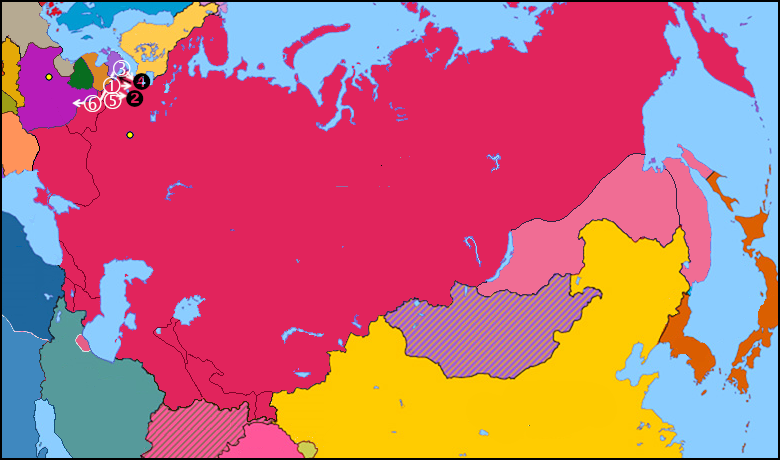
(1) Under Estonian protection the White Russians assembled an army (the "North-Western Corps") which eventually was able to just establish itself around the Pskov area. It was politically very fractious, but survived because the Soviets saw it as a small threat and prioritised other theatres. It renamed itself the NorthWestern Army and launched an attack on Petrograd in mid-1919.
(2) The Soviets saw that attack off reasonably easily, as it was poorly led and supplied. It became clear that the Estonian units would not fight other than to protect Estonia.
(3) Briefly united under General Iudenich, and much better supplied by the British, another attack in October 1919 reached the edge of Petrograd.
(4) The Bolsheviks rushed every force they could to the area, mobilising sailors, factory workers, kursanty etc. Once stopped the much smaller White army was unable to hold its ground and was rapidly thrown back into Estonia. It was dissolved soon afterwards.
(5) In the later period of the NW Army, the Pskov area came under the control of Bulak-Balakhovich, who effectively ruled the area as a warlord. While of doubtful morals, he was a very effective commander. He operated to the south of the main drive of the NW Army when it attacked Petrograd.
(6) After the failure of the drive on Petrograd, Bulak-Balakhovich penetrated the Soviet lines and took many of his men with him to Poland rather than be disbanded. There he assembled a "Belorussian National Army" and fought the Soviets.
The terrain in this area is much more closed than the southern and eastern fronts, with lots of forests, villages, marshes, streams and farms. This made cavalry operations problematic (and why Bulak-Balakhovich operated to the south, where it was a bit more open).
Poland
Polish-Soviet Fronts
The last of the genuinely large fronts, fought when the White armies were largely contained.
Size: large
Uniforms: lots of variety for Poles vs standard Red Army
Cavalry: lots
Troop types: big range for Poles, less so for Reds
Armour: plentiful, including tanks for Poles
Information: plenty
My conclusion: a good theatre to game, with interesting terrain and varied troop types. Although it lasted two years, in practice the more contested part of the war was focussed on a handful of battles in mid to late 1920, which are easy enough to find information about.
Researching Polish uniforms is a nuisance, but often other troop types can be pressed into service (French as the "Blue" army, Germans/Freikorps as the Poznanians, Austrians as Legion, Russians for the cavalry) which can reduce the investment needed.
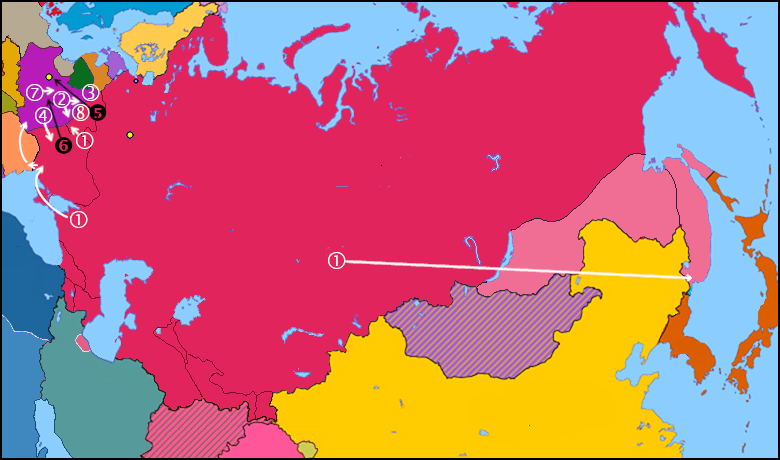
(1)There were some sizeable ethnic Polish units in Russia that attempted to return home, armed, with the surrender of Russia at Brest-Litovsk. Dowbor-Musnicki's I Corps did return to Poland, but unarmed. II Corps however ended up fighting the Germans near Kaniow in May 1918, and were forced to disband. III Corps attempted to remain in western Ukraine, were defeated by local Ukrainians, and surrendered to the Austro-Hungarians.
The Volunteer Army formed a unit of Poles, which they transferred to Odessa as the 4th Polish Rifle Division. They fought alongside the French until retiring to Romania, later making their way into the Ukraine to join up with Polish forces there. The 5th Polish Rifle Division formed in Siberia and returned years later via Vladivostok.
(2) In 1919 the new Polish state met the Soviet screens following the retreating Germans, but it was all very low level stuff at the start. As the Polish state grew their forces on their eastern border did too, but Pilsudski decided that he preferred the Soviets to beat the Whites, so deliberately did not scale up the fighting in late 1919 when the Bolsheviks were at their most vulnerable. Up to this point the fighting was largely in northern Belorussia.
(3) There was one push over the winter of 1919 when the Poles, in co-operation with Latvians, seized Daugavpils – which they then handed over to Latvia. The Reds did not put up strenuous resistance as the Poles had limited aims and were not striking at vital Soviet interests.
(4) By Spring of 1920 it was clear that the Russian Whites were going to lose, so Pilsudski struck. His plan was to form a ring of independent anti-Russian nations to contain the Soviets. The Poles drove deep into the Ukraine, taking Kiev in May 1920. They formed an alliance with the Ukrainian UNR under Petliura, and attempted to establish a Ukrainian buffer state.
At this point the war changed character utterly. The Bolsheviks had previously been happy to contain the Poles while they focussed on more important fronts. The fighting, as a result, was low-level and the Poles always had the initiative.
(5) Now an enormous army was raised in Belarus under Tukhachevski, which broke the Polish lines almost immediately, forcing a retreat to just in front of Warsaw. There was heavy fighting to the east and north of the Polish capital, but the Polish lines held, just.
(6) Simultaneously the Soviet South-western Front was reinforced by Budenny's Horse Army. It broke the Polish lines soon after arriving, and the front quickly moved back to just in front of L'viv. The Horse Army by-passed that city, but at Zamosc the Poles managed to form and hold.
(7) Unfortunately for the Soviets, the lack of co-ordination between the two drives resulted in a massive hole opening up in between them. Taking full advantage of that, Pilsudski launched a devastating counter-attack. The Soviet armies in northern Poland fled back to the Nemen, with many surrendering or being forced into internment in German Prussia. Meanwhile Budenny was repelled, his army very nearly encircled, and then forced to retreat. It was withdrawn from this front, and sent to fight Wrangel.
(8) The Poles, pressing home their advantage, fought a battle on the Nemen, largely with infantry, which resulted in further gains.
(9) In the south the Polish cavalry was able to raid multiple times deep into the Soviet rear. This forced the Red lines back without having to launch a massive offensive.
The Soviets signed a peace treaty which left Poland with major gains in Belorus and the Ukraine. (Note, modern Poland's borders resemble those of the 1920 Republic only along the Czech border; the country is now far more westerly than it was then.)
The main theatres of the war are quite flat and have interesting amounts of villages, forests, rivers etc. Unlike most of the RCW, the war was not largely along rail lines.
Other Polish Fronts
The war between independent Poland and the Soviets tends to dominate the histories, but there were lots of side theatres and other actors fighting at the same time.
Size: small
Uniforms: khaki
Cavalry: some
Troop types: mostly good
Armour: little
Information: not much
My conclusion: because these battles involve armies that are used for other major theatres, they are quite accessible once you have those figures. Researching them can be a pain though.
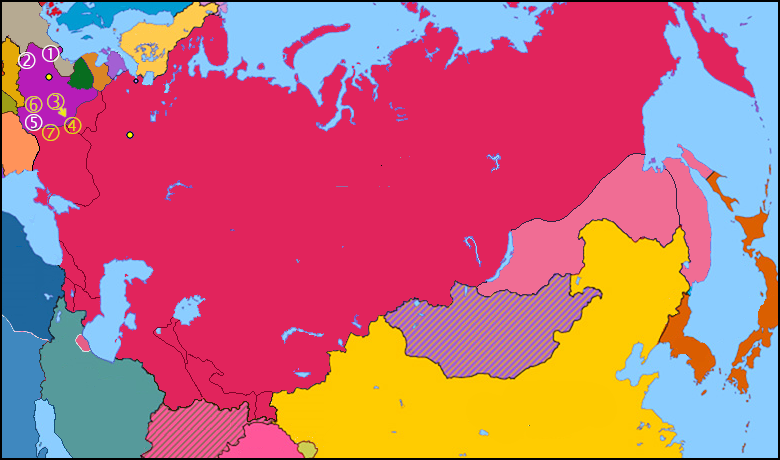
(1) The border between Germany and Poland was the source of a lot of fighting as the new country formed. The areas of Pomerania and Poznania that had dominant Polish populations declared for Poland but control of the towns was disputed, as that is where the Germans tended to live.
(2) Between August 1919 and July 1921 there were a series of uprisings in Silesia, which was being divided between Poland and Germany by plebiscite. The last of these became open warfare, as Freikorps battled local Poles, culminating in the Battle of Annaberg. The Poles and Czechs also had some squabbles over parts of Silesia, but these remained minor
The Polish army fighting the Soviets in 1920 included several other nationalities. Some Cossack cavalry units defected en masse and fought as part of the Polish army.
(3) Bulak-Balakhovich, who had moved from the NorthWestern Army, was allowed to recruit a battle group from Red Army defectors and prisoners. He operated alongside the Poles in the Polesie area in 1920. This was quite a seasoned unit by this stage, given that almost all his men were veterans before joining him.
(4) After the Polish-Soviet peace treaty was signed, Bulak-Balakhovich's "Russian People's Volunteer Army" invaded Belarus hoping that the population would rise to support him. He made some gains, but the population were too tired of war, and by this stage the Bolsheviks had started to make concessions to the peasants in order to calm the constant rural uprisings. Hopelessly outnumbered, he was forced back into Polish territory.
(5) In early 1919 while fighting the Soviets in the north the Poles were fighting the Ukrainian UGA in the south. Initially it went well for the Poles, and the Ukrainians were forced back into a small pocket around Chortkiv. However the UGA were surprisingly resilient, and launched an offensive that was initially very successful. Weight of numbers and lack of any supply however ensured that the Poles would win. The UGA collapsed and surrendered to the invading Soviets. From time to time the Poles did also fight the UNR in 1919, but only when they were in each other's way.
(6) The southern end of the Polish line in 1920 was occupied by their Ukrainian UNR allies. Typhus and lack of supply rendered much of the army unable to fight, but a couple of division's worth did continue to hold off the Soviets.
(7) With the end of the war, the UNR was also not willing to give up. They launched their October 1921 "Winter Offensive" over the borders into the Ukraine, although these were more raids than conventional warfare.
Allied Interventions
People new to the period often think that the foreign interventions would have pitted veteran Allied forces against Trotski's Red Army. In practice it was nothing like that.
The interventions were all on the periphery of Russia, so their opponents were poor quality local opponents. The Allied forces sent were not veterans – but men sent from side theatres, often completely green. On top of it all, the major interventions occurred after WWI was over, so struggled with unmotivated men, who just wanted to go home.
Size: small
Uniforms: standard WWI for the foreign powers, motley for their opponents
Cavalry: almost none
Troop types: mostly poor quality
Armour: Odessa and Murmansk had tanks, Baku had cars
Information: plenty
My conclusion: generally gamed as a way to use WWI figures or tanks. In practice they would make good display scenarios, but the actual amount of fighting doesn't warrant investing in armies of new figures.
Other than the Trans-Caspian, they also don't have what most people think makes the RCW cool: there's no unique units, cavalry or sweeping movement. You might as well just play Palestine if you want Brits in tropical kit, or WWI if you want tank assaults.
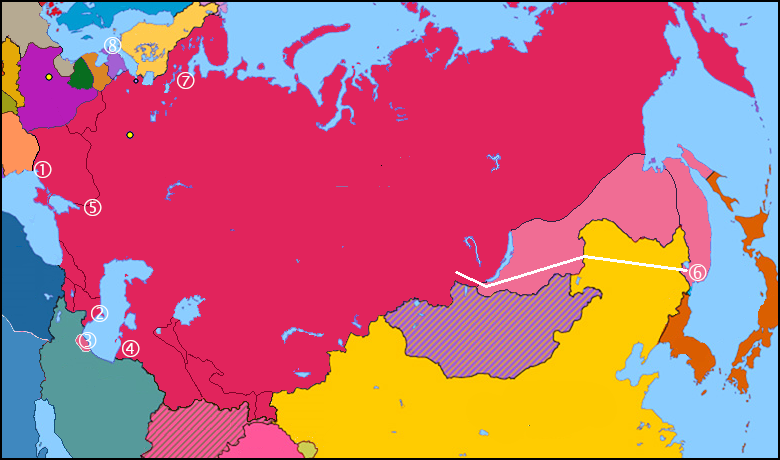
(1) The French landed in Odessa in early 1919, but much of the fighting was done by their Greek allies. They soon lost heart and left. Their enemy was officially the Ukrainian Red Army, but in practice it was Grigoriev's hastily cobbled together forces, not Trotski's. There were a couple of set piece battles.
(2) There was a brief British intervention in Baku ("Dunsterforce") fighting the Turks and their allies. The British fought for a couple of days then left. You get basically one day's fighting unless you go to "what ifs".
(3) A weird one, included for completeness. In May 1920 the Soviet Caspian Fleet attached the Persian port of Anzali, where some British troops were stationed and some Whites had fled. Typically for the interventions, the British evacuated rather than fight. A brief Persian Soviet Socialist Republic was set up, but when it set out to take over the country it was defeated by the new Persian government (set up and supported by the British). If the PSSR had lasted into 1922 it might have been able to get support from the USSR, which could generate some interesting scenarios.
(4) The British ("MalMiss") fought a short campaign in the Trans-Caspian, including with Indian cavalry. Technically they had White allies, but in practice they did most of the fighting while they were there. This is quite fun, easily the best of the interventions to wargame, with a half-dozen actions as they advanced down the rail line.
(5) The British supplied advisors, trainers, tanks and planes, with crews, to the AFSR, but no units as such. Their men fought quite a lot, but only ever as part of White Russian armies.
(6) British, French, Americans and Japanese landed in Vladivostok. The British sent some men east, but they never reached the front. The French left almost immediately. The US did defend the rail lines, but it was all very small scale stuff fighting partisans. The Japanese were the only ones who really intervened in any direct fashion, in particular propping up Semenov in Chita. But their opponents were almost entirely partisans, and then towards the end the FER, rather than the Red Army proper.
(7) The British and Americans landed in Murmansk and Archangel towards the end of 1918. This was the one intervention where they stayed a long time and actually fought the Red Army, albeit on a relatively small scale. The rough and forested terrain meant that they were unable to threaten Lenin's centres of power in any serious manner, and he simply posted enough troops to contain them, without any serious attempt to throw them out – other theatres were higher priority, and there was also good propaganda to be made out of having foreign troops on Russian soil.
(8) The British supplied a half-dozen tanks with crews to the North-Western Army. The Royal Navy also patrolled the Baltic, launching one raid on the Russian fleet in Petrograd and supporting the Latvians in Riga.
Other
Internal Soviet Fronts
The Soviets faced a number of internal fronts long after the Whites were defeated. The Red Army recorded combat losses in regular units in 1921 as over 170,000 men, and in 1922 nearly 21,000, so the scale of the fighting was substantial.
Size: small scale, as military actions
Uniforms: none or standard Red Army
Cavalry: lots for Soviets
Troop types: not much variety
Armour: cars and planes for Reds
Information: plenty for Antonov and Kronstadt; nothing for the rest
My conclusion: almost any other theatre is more interesting. It is a way to play a game if you only have Reds though.
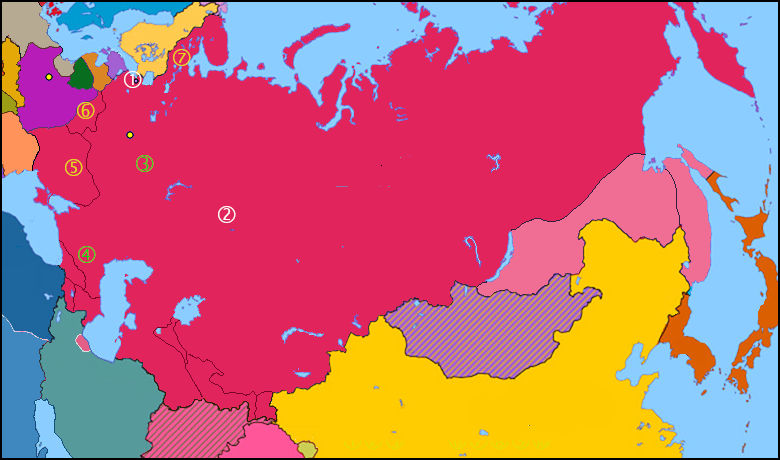
The Soviets faced a large number of rebellions inside Russia as their policies began to bite. Most of these were buried by the Soviets though, so are not at all well known, even in Russian. The Basmachis are noted above.
(1) The Kronstadt revolt, gained much publicity in the West and could not be air-brushed out. The risk with it was political contagion, not military, although substantial forces were assembled to assault the island.
(2) There were other military rebellions and mutinies, which were largely kept out of the history books. One such was in January 1921 as insurgents took Tobolsk and Ishim, then nearly Tyumen. The fighting was intense and it took a year for the rebellion to be fully suppressed.
There were a lot of peasant revolts after the civil war, with many in Siberia and across the Ukraine. Generally they were not centrally organised and suppressed relatively easily.
(3) The most serious, because the most organised, was the Tambov revolt under the leadership of Antonov. He was able to defeat several units sent to crush him. The Soviets eventually realised that their infantry was too slow, and anyway tended to have some sympathy for the insurgents. Accordingly, they started to use their veteran cavalry, who tended to be politically more sure, and back them up with planes, cars and artillery. Accompanying this was a strong Cheka campaign to target the rebels by amnesty and assassination, using informants wherever possible. In the end, the concession of the NEP was a major factor in calming the population; the rebel peasants effectively winning their primary objective (albeit very temporarily).
Similar methods were used to finish off the Makhnovshchina. A substantial military and political campaign was launched against it, but it was mid-1921 before Makhno was forced into exile. His movement did not last long without him.
(4) Another area that rose into major revolt was the Kuban. Although not centrally organised, several factors operated to make this area much more difficult for the Soviets to control. Most of them were Cossacks, and so were quite comfortable with irregular warfare. The terrain, with mountains and marshes, was much more conducive to hiding than the plains of, for example, the Don Cossacks. And the population did not contain substantial areas friendly to the Soviet regime, other than a few cities.
(5) The Ukrainian nationalists, despite being militarily weak, were hard to suppress politically. The last hold-out of the UNR was the Kholodny Yar Republic, which lasted into 1922, using Kholodny Yar forest to protect it. Eventually crushed by the Cheka, rather than force, its history was hidden by the Soviets.
(6) In November 1920, proclaiming a separate Belarus, a rebellion near Slutsk broke out. Although only a few regiments worth of rebels, the local Red Army tended to sympathise. Eventually Latvian and Chinese units were brought in. The rebels were forced to retreat to Poland within a month.
(7) There was a rebellion in East Karelia from November 1921 to March 1922. Some Finnish volunteers joined to fight alongside the Karelians seeking independence from Russia. It very small scale.
Caucasian States
Similar to the Baltic states, the Caucasian ones had a confused history during the Russian Civil War, caught between larger nations bent on expanding at their expense.
Size: small
Uniforms: generally ex-WWI
Cavalry: some irregulars, especially Azerbaijani
Troop types: generally poor quality
Armour: none, other than Soviets
Information: some
My conclusion: perhaps, if you have heritage from the area or you actively want a game in mountain terrain.
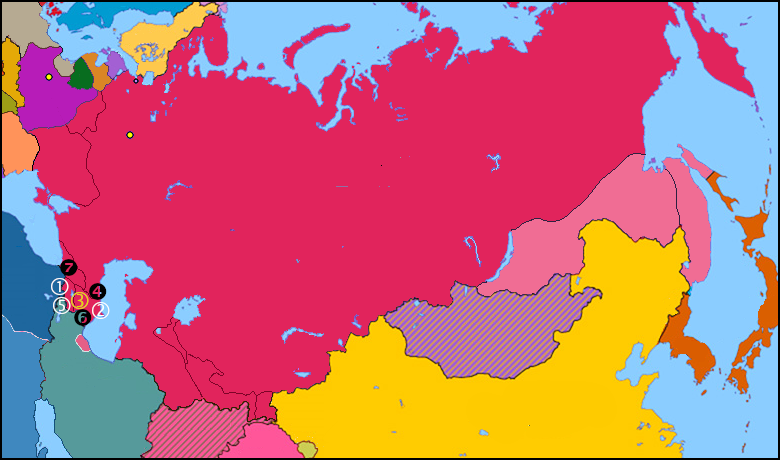
With the revolution, the Caucasian lands originally tried to form a government together, but there were too many competing interests. The three separate nations started to form separately.
(1) In early 1918 the Ottoman Empire invaded the newly formed Armenia, attempting to take its territory. The climax was the Battle of Sardarabad, which was a major victory for Armenia. The Turks were repelled and the new Armenian state greatly enlarged.
(2) Baku was initially held by a revolutionary group of largely Russians (the delightfully named "Centrocaspian Dictatorship"), with local Armenian support. A force of Azerbaijanis, aided by some Turks, invaded in June 1918 and swiftly fought their way to the city. It was at this point that Dunsterville's forces turned up, and the Soviets were removed. After a brief defence, Baku soon fell.
At this point the Ottoman Empire was forced into the Treaty of Sèvres, as a result of its losses on other fronts. The newly emerging Turkey then fought a major war against Greece, and also the occupying Fench, before the Turks could once more turn their attention to the Causcasus.
(3) After a very brief war with Georgia, Armenia then entered a much more prolonged struggle against Azerbaijan – for control of the territories that are still disputed by those revived nations even now.
(4) Preoccupied with Armenia, Azerbaijan was invaded in April 1920 by the Soviets, who desperately needed its oil wells. Their army facing the wrong way, the country was occupied very easily.
(5) In September 1920 the Turks once more invaded Armenia, intending to conquer it all. They made solid progress and looked like they would succeed.
(6) However the Soviets took advantage of the distracted Armenian army and invaded from Azerbaijan. Already losing the war against the Turks, the country was swiftly over-run. The current, small, Armenia is as a result of the Soviet-Turkish Treaty of Kars, which left Turkey in possession of their gains in 1920.
(7) Finally, in February 1921 Georgia was invaded by the Soviets (in blatant violation of an earlier peace treaty). The Georgians put up stubborn resistance, but were overwhelmed in a month.
(8) While each conquered quickly enough, all three Caucasian states had major uprisings in the following years.